Thursday, December 14, 2006
Hadhrat Uwais Qarni RH
HADHRAT UWAIS QARNI (rahmatullah alayh)
1. Regarding Uwais Qarni (rahmatullah alayh), Rasulullah ( صلى الله عايه وسالم ) said: "Uwais Qarni is the noblest of the Tabieen with ihsaan." (The highest stage of ihsaan is to worship Allah Ta'ala as if you are seeing Him.)
Sometimes Rasulullah ( صلى الله عايه وسالم ) would turn in the direction of Yemen and say: "I perceive the fragrance of love from Yemen."
Rasulullah ( صلى الله عايه وسالم ) said: "Tomorrow on the Day of Qiyaamah Allah Ta'ala will create 70,000 malaa-ikah in the image of Uwais Qarni who will enter in their midst into Jannat. No one will recognise him except those whom Allah wishes." Since he engrossed himself in ibaadat in concealment, fleeing from people, Allah Ta'ala will preserve his concealment even in the Aakhirah. Allah Ta'ala has said: "My Auliyaa are under My Mantle. None besides Me knows them."
Rasulullah ( صلى الله عايه وسالم ) said: "In my Ummat is a man whose shafaa'at (intercession) will be accepted on behalf of so many people whose number equals the hairs on the sheep/goats of the tribes of Rabeeh and Mudhir."
These two Arab tribes possessed the most sheep and goats, hence the analogy. When the Sahaabah enquired about the identity of this man, Rasulullah (b) said: "A servant among the servants of Allah." The Sahaabah responded: "We all are the servants of Allah. What is his name?"
Rasulullah ( صلى الله عايه وسالم ) said: "Uwais Qarni."
Sahaabah: "Where is he?"
Rasulullah ( صلى الله عايه وسالم ): "In Qarn."
Sahaabah: "Have he seen you?"
Rasulullah ( صلى الله عايه وسالم ): "Not with his physical eyes, but he has seen me with his spiritual eyes."
Sahaabah: "Such an ardent lover, but why has he not entered into your companionship?"
Rasulullah ( صلى الله عايه وسالم ): "There are two reasons. The first is ghalbah haal (i.e. he is always in a high spiritual state which makes him oblivious of everything besides Allah Ta'ala). The second is his profound observance of my Shariat. His mu'minah mother is extremely old and blind. He tends to camels and with his earnings he supports his mother."
Sahaabah: "Can we see him?"
Rasulullah ( صلى الله عايه وسالم ) said to Hadhrat Abu Bakr (d): "You will not see him, but Umar and Ali will see him. His entire body is covered with hair. On the palm of his hand and left side is a white spot, the size of a dirham, which is not the mark of leprosy. When you meet him, convey my salaam to him and tell him to make dua for my Ummat. Among the Auliyaa those who are the Atqiyaa (a very loft category of Auliyaa), he is the holiest."
Sahaabah: "Where shall we find him?"
Rasulullah ( صلى الله عايه وسالم ): "In Yemen, he is a camel-herd known as Uwais. You should follow in his footsteps."
As Rasulullah's ( صلى الله عايه وسالم ) demise neared, the Sahaabah asked: "To whom shall we give your jubbah (cloak)?"
Rasulullah ( صلى الله عايه وسالم ) said: "To Uwais Qarni."
After the demise of Rasulullah ( صلى الله عايه وسالم ) Hadhrat Umar and Hadhrat Ali (dma) journied to Kufa. After delivering a Khutbah, Hadhrat Umar (d) said: "O people of Najd, all of you stand up." Everyone obeyed. He then enquired: "Is any among you from Qaran?" When they said, 'yes', he asked for information about Uwais Qarni.
They replied: "We do not know him. However, there is a madman who has become estranged from people. He flees from people. When Hadhrat Umar (d) enquired of his whereabouts, he was told that he (Uwais Qarni) tends to camels in Wadi Urnah. At night he eats dry bread. He does not enter the town. He does not speak to anyone. He does not eat what people generally eat. He does not know what is grief and happiness. When people laugh, he cries. When they cry, he laughs."
Hadhrat Umar and Hadhrat Ali (ra) travelled to that valley (Wadi Urnah). Ultimately when they discovered him, he was engaged in Salaat. By the command of Allah, angels were tending to the camels. On perceiving the presence of human beings, Uwais terminated his Salaat, and said "Assalaamu Alaikum".
Hadhrat Umar Farooq () replied: "Wa-Alaikum Salaam", and asked: "What is your name?"
Uwais: "Abdullah (i.e. a slave of Allah)."
Hadhrat Umar: "We all are the servants of Allah. What is your specific name?"
Uwais: "Uwais".
Hadhrat Umar: "Show me your right hand."
When Hadhrat Uwais showed his hand, Hadhrat Umar (d) seeing the mark indicated by Rasulullah (b), kissed his hand, and said: "Rasulullah ( صلى الله عايه وسالم ) has conveyed salaams to you; sent this cloak for you and commanded that you make dua for his Ummah."
Uwais: "You are more qualified to make dua because there is no one nobler than you."
Hadhrat Umar: "I am always engaged in this duty of dua. However, you have to comply with the order of Rasulullah (b)."
Uwais: "O Umar! Think carefully. Perhaps Rasulullah ( صلى الله عايه وسالم ) had in mind someone else besides myself."
Hadhrat Umar: "All the signs indicated by Rasulullah ( صلى الله عايه وسالم ) exist in you."
Uwais: "Give me the cloak of Rasulullah ( صلى الله عايه وسالم ) so that I may make dua."
Taking the cloak, Hadhrat Uwais said: "Wait here."
He went a distance, fell into Sajdah and supplicated: "O Allah! I shall not don this mantle as long as You do not forgive the entire Ummah of Muhammad ( صلى الله عايه وسالم ), for he has presented this cloak. Rasulullah ( صلى الله عايه وسالم ), Umar Farooq and Ali Murtaza have discharged their duties."
A Voice exclaimed: "We have forgiven a number by virtue of your intercession."
Uwais: "O Allah! As long as You do not forgive all, I shall not don this mantle."
The Voice: "I have forgiven thousands."
Uwais: "I am petitioning for the forgiveness of all."
This performance was enacted several times. Each time, The Voice announced an increase in the number of persons forgiven by virtue of Hadhrat Uwais' intercession. Meanwhile Hadhrat Umar and Hadhrat Ali () unable to hold their patience came near to Hadhrat Uwais to see what was happening. When Hadhrat Uwais saw them, he exclaimed: "Why have you come? I would not have donned this mantle as long as Allah Ta'ala had not forgiven the entire Ummah of Rasulullah ( صلى الله عايه وسالم )."
Gazing at Hadhrat Uwais with deep intent and concern, Hadhrat Umar () perceived 18,000 spiritual kingdoms under the simple shawl Hadhrat Uwais was wearing at the time. Hadrat Umar (), now overwhelmed by spiritual enthusiasm, lost complete interest in himself and his Khilaafat. In an ecstatic mood he cried out: "Is there anyone prepared to accept my Khilaafat in exchange for a piece of bread?"
Hadhrat Uwais said: "Only a man lacking in intelligence, will purchase it. What are you talking of buying and selling! Abandon it! Whoever wishes, can pick it up."
Then donning the mantle of Rasulullah ( صلى الله عايه وسالم ), Hadhrat Uwais said: "As a result of the barkat of this mantle and my intercession, the number of people of the Ummah of Muhammad (b) forgiven, equals the number of hairs on the bodies of the goats of the tribes of Rabeeah and Mudhirr."
Hadhrat Umar: "O Uwais, why did you not meet Rasulullah ( صلى الله عايه وسالم )?"
Uwais: "Perhaps you saw the blessed forehead of Rasulullah ( صلى الله عايه وسالم ). Tell me, were Rasulullah's (b) eye-brows fine or broad?" [Arabic in manuscript margin, bk 1, pg 31]
Surprisingly, neither Hadhrat Umar () nor Hadhrat Ali () was able to describe Rasulullah's ( صلى الله عايه وسالم ) eye-brows.
Uwais: "You are he Companions of Muhammad ( صلى الله عايه وسالم )?"
Hadhrat Umar: "Most certainly we are."
Uwais: "On the day when the blessed tooth of Rasulullah ( صلى الله عايه وسالم ) was martyred, why did you not martyr your own teeth? The requirement of love was that you conformed."
Hadhrat Uwais opened his mouth and they observed that all his teeth were missing. He said: "I broke my teeth without seeing the mubaarak face of Rasulullah (b). After having broken a tooth, I was not satisfied. Perhaps another tooth of Rasulullah ( صلى الله عايه وسالم ) was martyred, not the one I broke in my mouth. In this way I continued breaking my teeth until all were removed.
Both Hadhrat Umar and Hadhrat Ali () were overcome with emotion. Now they learnt a new concept of love and devotion. They resolved to learn this devotion from Hadhrat Uwais. Hadhrat Umar () then said: "O Uwais, make dua for me."
Uwais: "I have already made dua. You should not desire more. In the Tashahhud of every Salaat I say: "O Allah! Have mercy on all the believing men and women and forgive them."
If you reach the grave with the safety of Imaan, then most certainly, you have obtained my dua. I do not want to destroy my dua.
Hadhrat Umar: "Counsel me."
Uwais: "Umar, have you recognized Allah Ta'ala?"
Hadhrat Umar: "Yes, I recognized Him." Uwais: "It is best that you recognize only Allah Ta'ala and no one besides Him."
Hadhrat Umar: "Say something more."
Uwais: "Allah Ta'ala knows you. It is best that besides Allah Ta'ala, no one else knows you."
Hadhrat Umar () then attempted to present a gift of some money to Hadhrat Uwais. Hadhrat Uwais producing two dirhams from his pocket, said: "This is my earning for tending camels. If you can vouch that these dirhams will be depleted before my death, I shall then accept more."
Obviously, Hadhrat Umar () could not comply, hence Uwais refused the gift.
Hadhrat Uwais: "Both of you had undergone considerable hardship to reach me. Now return. Qiyaamat is near. We shall then meet where there shall no longer be any separation. Presently I am in a dilemma. I am concerned with the preparations for this journey." They bid farewell and took leave with heavy hearts.
2. After the departure of these two eminent Sahaabah, people began to honour Hadhrat Uwais. Since their excessive veneration agitated him, he fled from that place. Thereafter he was not seen again by anyone except once by Hiram Ibn Hibbaan (rahmatullah alayh) who gave the following account of his encounter with Hadhrat Uwais (rahmatullah alayh):
"When I heard of the status of the Shafa'at (Intercession) of Hadhrat Uwais, I was overtaken by an intense yearning to meet him. I went to Kufaa and set out in search of him. It was my great fortune to locate him making wudhu on the banks of the river Euphrates. I found him fitting the description of him I had heard. After exchange of Salute actions, he looked intently at me. I desired to shake his hands, but he refused. I said:
"Uwais, may Allah have mercy on you and forgive you."
His physical weakness and forlornness reduced me to tears in profusion. Uwais (rahmatullah alayh) also wept and said: "Hiram Ibn Hibban, may Allah Ta'ala grant you a good reward. What has brought you here? Who showed you the road to me?"
Hiram Ibn Hibban: "How do you know my name and the name of my father? You have never met me before."
Hadhrat Uwais: "He Whose Knowledge is all-encompassing has informed me. My rooh has recognized your rooh because the arwaah (souls) of the Mu'mineen recognize each other."
Hiram: "Narrate a Hadith of Rasulullah ( صلى الله عايه وسالم ) to me."
Hadhrat Uwais: "I did not meet Rasulullah ( صلى الله عايه وسالم ), but I have heard of his attributes from others. I have no desire to be a Muhaddith or a Mufti or a narrator because I am engrossed in an abundance of activity."
Hiram: "Recite an aayat of the Qur'aan so that I hear it from your blessed tongue."
Uwais: After reciting
he wept uncontrollably and recited: "I did not create jinn and man except that they worship Me."
Then he let out such a frightening screech that I thought he had become insane. He said: "O Ibn Hibban, what has brought you here?" I replied: "To become your friend and to reform myself." Hadhrat Uwais commented: "I cannot even think of a man who has recognized Allah Ta'ala, having any love and desire for others and deriving comfort from others besides Allah." I said: "Give me some naseehat".
He replied: "Keep Maut under your pillow when sleeping. When you wake up, don't cherish hope of life. Never consider sin as being minor. If you consider sin as being minor, know that you are considering Allah Ta'ala as being insignificant."
I asked: "Where should I take up residence?" He said: "In the Land of Shaam." I said: "How shall I earn my living there?"
Hadhrat Uwais said: "Alas! Pity those souls who are beset with doubt and uncertainty and refrain from accepting naseehat."
I said: "Give me more naseehat." He said: "O son of Hibban! Your father has died. Aadam, Hawwaa, Nooh, Ibraaheem, Musaa, Daawood (alayhimus salaam), all have died. Muhammad ( صلى الله عايه وسالم ) too have died. Abu Bakr, the first Khalifah has also died and my brother Umar has departed from this earthly abode. Oh Umar! Oh Umar!"
I said: "May Allah have mercy on you. Umar has not yet departed." Hadhrat Uwais said: "Allah Ta'ala has informed me of his demise. You and I are among the dead."
He then recited Durood and made some dua, and added: "It is my advice that you cling to the Kitaab of Allah and adopt the path of Islaah (moral reformation). Never for a moment be forgetful of Maut. Never take even one step beyond the fold of the Jama'ah of the Ummah of Muhammad ( صلى الله عايه وسالم ), for then, Allah forbid, you will become without Deen and land in Jahannum." After making dua, he said: "Son of Hibban, go! Neither will you see me again, nor will I see you. Remember me in your dua. I too shall remember you in my dua. Now don't follow me, I am going."
I desired to accompany him a few steps, but he refused. He wept and so did I. I gazed long after him until he disappeared from sight. Thereafter, I never again heard of him.
3. Hadhrat Rabee' (rahmatullah alayh) gives the following narrative of his encounter with Hadhrat Uwais Qarni (rahmatullah alayh): "I set out with a yearning to meet Uwais. I found him engaged in Fajr Salaat. As he completed his Salaat, he immediately commenced thikr. He continued with thikr until Zuhr. After Zuhr he again became involved in thikr until Asr. In this way he continued until Fajr of the next day. He maintained this practice for three days. During this entire period he neither ate nor slept. On the fourth night he took a short nap. He suddenly awoke with a start, jumped up and supplicated:
"O Allah! I seek Your protection from sleeping to the satisfaction of the eyes and from eating to the satiation of the stomach."
On hearing this, I decided that I had seen enough and returned."
4. His practice was to remain awake in ibaadat the entire night. He would say: 'Tonight is the night of Sajdah; tonight is the night of Ruku'; tonight is the night of Qiyaam.' In the way would he spend the nights worshipping Allah Ta'ala.
5. Someone asked: "How should Salaat be performed?" Hadhrat Uwais said: "I desire that before completing in Sajdah (during the night) it is already morning. Ibaadat should be like the worship of the Angels."
6. Someone asked: "What is khushu' (concentration in Salaat)?" He replied: "If you are struck with a spear, you remain oblivious of it."
7. He was asked: "How are you?" He said: "Like one who gets up in the morning, not knowing if Maut will grant him respite until the evening."
8. Hadhrat Uwais said: "A man who loves three things, Jahannum is closer to him than his jugular vein: Delicious food; fine garments and association with the rich."
(This naseehat does not apply to the masses who find it difficult to abstain from even haraam on account of extreme deficiency of Imaan. The advice of Hadhrat Uwais–(rahmatullah alayh)–is directed to Auliyaa of high rank. As far as weaklings engrossed in material pursuits are concerned, the minimum demand is to eat, drink and participate in worldly affairs within the permitted confines of the Shariah–in moderation.)
9. People said to Hadhrat Uwais: "There is a man nearby who has been sitting in a grave with a kafan for the past 30 years, weeping profusely."
On his request, Uwais was taken to view this man in the grave. The man was reduced to a skeleton. He was like a dried out weed and was crying. Hadhrat Uwais said: "The kafan and the qabar have diverted you from Allah. Both these objects constitute a veil for you in the Path (leading to Allah Ta'ala)."
His statement struck a responsive chord in the heart of the man. His spiritual eyes opened and he realised his folly. He let out a terrible scream and expired in that grave in which he had spent 30 years.
If even the grave can become a veil and an obstacle in the path of spiritual progress, what is the effect of the numerous other pursuits and objects of the material world?
10. Once for three days he was without food. On the fourth day he found a dinaar (gold coin) laying on the ground. Thinking it to be the lost property of someone, he left it. As he walked on, a wolf with a loaf of bread in its mouth approached him. The wolf left the bread infront of him. Uwais thought that the wolf had snatched the bread belonging to someone. As he thought, the wolf said: "I am the servant of the Same Being Whose servant you are." The wolf then disappeared. Hadhrat Uwais realising that the bread was sent by Allah Ta'ala, ate it.
11. Hadhrat Uwais said: "Nothing remains hidden from a person who has recognized Allah Ta'ala." "Safety is in solitude. True solitude is that there is no room in the heart for thinking of others. Solitude in which the mind is occupied with the thoughts of others is defective."
"When two people gather to indulge in futility, shaitaan departs because he has achieved his objective. There is no longer a need for his presence since these two are sufficient to deceive each other. Both are forgetful of Allah Ta'ala." "Keep your heart alert so that aliens do not gain entry." (i.e. Always remember Allah Ta'ala, for Thikrullah prevents shaitaan from entering the heart of man.)
"I searched for glory and I found it in humility. I searched for kingdom and I found it in admonishing people (i.e. giving them naseehat). I searched for culture and found it in truth. I searched for holiness and found it in poverty. I searched for Nisbat and found it in piety. (Nisbat refers to a special relationship of proximity with Allah Ta'ala.)
I searched for honour and I found it in contentment (i.e. contentment with whatever Allah Ta'ala has ordained). I searched for comfort and found it in zuhd (abstinence –renunciation of the world). I searched for independence and found it in tawakkul (trust in Allah)."
12. When Hadhrat Uwais walked in the road, mischievous children considering him to be a mad man would pelt him with stones, mocking and jeering. He would say: "Pelt me with small stones. Big stones draw blood which breaks my wudhu."
13. It is narrated that towards the close of his life he joined Hadhrat Ali (d) in the Battle of Siffeen and was martyred. Among the Auliyaa there is a category called Uwaisiyyah. Those in this class do not need a Shaikh (Spiritual Mentor). Just like Hadhrat Uwais, they acquire spiritual elevation without the medium of a Shaikh. Hadhrat Uwais (rahmatullah alayh), despite not having physically associated with Rasulullah ( صلى الله عايه وسالم ) gained spiritual elevation by virtue of Nabi-e-Kareem's (b) baatini (spiritual) medium. This pedestal occupied by these Auliyaa is extremely lofty. Only Allah Ta'ala decides who is to be favoured with this rank.
previous
next
up
HADHRAT ABU MUHAMMAD JA'FAR SAADIQ (rahmatullah alayh)
HADHRAT HASAN BASRI (rahmatullah alayh)
printer-friendly version view as pdf 409 reads
mail to webmaster for questions and comments on this website.back to TheMajlis.net
_uacct = "UA-340342-4";
urchinTracker();

Wednesday, December 13, 2006
Home » SCATTERED PEARLS » HADHRAT ABU MUHAMMAD JA'FAR SAADIQ (rahmatullah alayh)
HADHRAT ABU MUHAMMAD JA'FAR SAADIQ (rahmatullah alayh)
One night Khalifah Mansur said to his wazir (prime minister): "Bring Saadiq to me. I want to slay him." Wazir: "Do you wish to slay a man who has renounced the world; who has adopted solitude; who is engrossed in the worship of Allah and who has no worldly designs?" Expressing his annoyance, the Khalifah said: "Go! Bring him so that I could slay him." Inspite of the wazir's pleas, the Khalifah remained adamant. Finally the wazir was constrained to summon Hadhrat Ja'far Saadiq (rahmatullah alayh). Meanwhile Mansur ordered his guards to kill Hadhrat Ja'far on his arrival. When the Khalifah removed his crown from his head it will signal the moment for slaying Hadhrat Ja'far. When Hadhrat Ja'far appeared, the Khalifah stood up in respect. With great honour and humility he welcomed Hadhrat Ja'far. In fact, he ran forward to greet Hadhrat Ja'far. He brought Hadhrat Ja'far to sit on the royal stage. The guards were greatly surprised by the reverence and honour which Mansur showed to Hadhrat Ja'far. The Khalifah said to Hadhrat Ja'far: "Is there any thing you need?" Hadhrat Ja'far: "Do not inconvenience me again by calling me. Leave me to worship Allah." Mansur allowed Hadhrat Ja'far to leave with utmost respect. After the departure of Hadhrat Saadiq, the Khalifah began to shiver uncontrollably and fell down unconscious. He remained unconscious for three days. According to some, he was unconscious for the duration of three Salaat which became qadhaa. When the Khalifah regained conscious, the wazir asked for an explanation. The Khalifah said: "When Saadiq entered, a huge serpent was at his side. The one jaw of the serpent was touching the ground and the other jaw, the ceiling. The serpent was implying to me: 'If you harm him I shall swallow you along with the whole stage." As a result of the fear for the serpent, the Khalifah did not know what he was saying or doing. He said: "I apologized and became unconscious." Once Hadhrat Daud Tai (rahmatullah alayh) said to Hadhrat Ja'far (rahmatullah alayh): "O son of Rasulullah ( صلى الله عايه وسالم)! My heart has darkened. Give me some naseehat." Hadhrat Ja'far: "O Abu Sulaiman! You are the zaahid of the age. You are not in need of my naseehat." Hadhrat Daud said: "O son of Rasulullah ( صلى الله عايه وسالم)! Allah Ta'ala has bestowed to you all excellences and virtues. It is incumbent on you to admonish everyone." Hadhrat Ja'far: "O Abu Sulaiman! I fear that on the Day of Qiyaamah my grandfather may apprehend me and demand: 'Why did you not fulfil the demands of my obedience?' This mission is not correctly discharged by genealogy. It is fulfilled by maintaining a beautiful relationship with Allah Ta'ala." Hadhrat Daud wept profusely and commented: "O Allah! When this is the state of him whose grandfather is the Rasool, whose mother is Faatimah (radhiyallahu anha) and who is a beacon of Knowledge, who is this non-entity Daud to become vain and proud?" One day Hadhrat Ja'far Saadiq (rahmatullah alayh) said to his disciples: "Come, let us pledge and promise that whoever among us will be saved on the Day of Qiyaamah, he will intercede on behalf of the others." The disciples said: "O son of Rasulullah ( صلى الله عايه وسالم)! What need do you have for our intercession when your grandfather will be the intercessor for entire creation?" Hadhrat Saadiq: "I feel ashamed of my deeds. How can I look my grandfather in the face on the Day of Qiyaamah?" When Hadhrat Ja'far Saadiq (rahmatullah alayh) went into solitude, refusing to emerge, Hadhrat Sufyaan Thauri (rahmatullah alayh) visited him and said: "O son of Rasulullah ( صلى الله عايه وسالم)! The people are deprived of your blessings. Why have you gone into solitude." Hadhrat Ja'far: "Now, I consider this to be appropriate. Trust has departed. People are engrossed in their own thoughts and needs. While they profess love and friendship, their hearts are filled with scorpions." 5. Once when a man saw Hadhrat Ja'far Saadiq (rahmatullah alayh) wearing fine, expensive garments, he commented: "O son of Rasulullah ( صلى الله عايه وسالم)! It is not befitting for the Ahl-e-Bait to wear such garments." Hadhrat Ja'far Saadiq took the man's hand and pushed it inside his (Ja'far Saadiq's) sleeve. The lining under the fine cloth was of such coarse sack-cloth which hurt the man's hand. Hadhrat Ja'far commented: "This (the external cloth) is for creation and that (the coarse lining) is for the creator." (His externally adorned garments were to conceal his piety while the simple coarse sack-cloth was the demand of his high level of piety.) 6. Hadhrat Ja'far Saadiq (rahmatullah alayh) asked Hadhrat Imaam Abu Hanifah (rahmatullah alayh): "Who is an intelligent man?" Imaam Abu Hanifah: "One who can distinguish between good and bad." Hadhrat Ja'far: "An animal is also able to distinguish between good and bad. An animal recognizes a man who is kind and cruel to it." Imaam Abu Hanifah: "Who then is an intelligent person?" Hadhrat Ja'far: "A person who is able to distinguish between two acts of goodness and two acts of badness so that he could choose the greater act of goodness and the lesser evil." (The rule of choosing the lesser evil applies when confronted by two evils and there is no third option. To save oneself from either of the evils has to be chosen. In such an eventuality, the lesser evil is adopted.) 7. A man whose purse containing gold coins was lost. He accused Hadhrat Ja'far Saadiq (rahmatullah alayh ) of having stolen it. This man was not aware of the identity of Hadhrat Ja'far. On asking the man about the contents of the purse, he said that the purse contained 1,000 dinars. Hadhrat Ja'far took the man home and gave him 1,000 dinars. A short while later when the man discovered his purse with the money intact, he returned to Hadhrat Ja'far Saadiq, presented the 1,000 dinars and apologized. Hadhrat Ja'far said: "I do not take back what I had given." When the man learnt who Hadhrat Ja'far Saadiq was, he left feeling very ashamed. 8. A man said to Hadhrat Ja'far Saadiq (rahmatullah alayh): "Show me Allah. I want to see Him with my eyes." Hadhrat Ja'far: "Have you not heard (i.e. in the Qur'aan) it is said to Musaa (alayhis salaam): 'You cannever see Me.' ?" The man said: "I have heard it. But this is the Millat (Deen) of Muhammad ( صلى الله عايه وسالم). Someone calls out: 'My heart has seen Allah'. Another says: 'I do not worship a being I cannot see'." (This man was referring to statements of the Auliyaa of this Ummah. If they could make these claims, then there can be nothing wrong in the demand to see Allah. So thought this man.) Imaam Ja'far Saadiq ordered his mureeds (disciples) to tie the man and toss him into the river Dajla. This was done. The water swallowed him. As he bobbed up, he cried: 'O son of Rasulullah ( صلى الله عايه وسالم), help! Help!' Hadhrat Ja'far exclaimed: 'O water take him.' The water submerged the man. This occurred several times. Each time when he surfaced, he cried out: 'O son of Rasulullah ( صلى الله عايه وسالم), help! Help!' Finally when he lost all hope, he called out: 'O Allah, help me!' Hadhrat Ja'far ordered his disciples to bring him out of the river. After the man had rested and gained his composure, Hadhrat Ja'far asked: "Did you see Allah?" The man: "As long as I called to others, there remained a veil concealing Allah. When I turned my attention only to Him, seeking His aid, a window opened up in my heart from which I saw Him." Hadhrat Ja'far Saadiq said: Aslong as you called: 'Saadiq! Saadiq!', you were a kaathib (liar). Now guard this window." (Saadiq means true. As long as the man was calling 'Saadiq', his belief in Allah was defective, hence Hadhrat Ja'far Saadiq described his as being kaathib. When he abandoned calling creation to aid him and turned his gaze to Allah, he became a true believer.) 9. Hadhrat Ja'far Saadiq (rahmatullah alayh) said: "A sin preceded by khauf (fear of Allah) and followed by taubah (repentance) draws the servant closer to Allah. Ibaadat preceded by and followed by ujub (vanity) takes the servant far away from Allah." (This statement should not be misunderstood. Sin never leads to the proximity of Allah Ta'ala. Sin leads to the Wrath and punishment of Allah. The statement here means that the person understands the act to be sinful. He does not justify the sin. He has no intention of committing the sin. He is always fearful of Allah's punishment. However, in a moment of weakness and negligence, his nafs overwhelms him and casts him into sin. He then regrets and repents.) 10. He said: "A man who is proud on account of his ibaadat, is a sinner and a sinner who regrets and repents is an obedient servant." 11. Hadhrat Ja'far Saadiq (rahmatullah alayh) was asked: "Who is superior–a patient durwaish or a wealthy man who is grateful?" Hadhrat Ja'far said: "The patient durwaish. The heart of the wealthy man is attached to his wealth while the heart of the durwaish is with Allah Ta'ala." (Durwaish or dervish–a pious poor person.) 12. He said: 'Ibaadat without taubah is not proper because Allah Ta'ala has placed taubah before ibaadat. The Qur'aanic aayat says: “Those who engage in Taubah, those who are involved in ibadah..” First taubah is mentioned. (This statement does not mean that ibaadat is not valid if not preceded by taubah. However, when a man contaminated by sin worships Allah, he does not derive the full benefit and reward of the ibaadat. The bandah–servant of Allah–should therefore, always repent.) 13. He said: "True Thikr (remembrance of Allah) is to forget everything else. Allah Ta'ala suffices for all the things forgotten by virtue of His Thikr." 14. He said: "A Mu'min is he who always stands in confrontation of his nafs. An Aarif is he who stands in the presence of Allah Ta'ala." 15. He said: "Whoever struggles against his Nafs-e-Ammaarah for the sake of Allah, finds Allah." 16. He said: "Ilhaam (inspiration from Allah) is an attribute of the accepted servants of Allah." 17. He said: "The attempt to rationally disprove ilhaam is a sign of the irreligious people." 18. He said: "Allah Ta'ala is more hidden in His servants than a black ant walking on a black stone in an intensely dark night." 19. He said: "The secret of reality was unlocked for me when I was branded a madman." (True lovers of Allah Ta'ala are generally branded as mad by people of the world.) 20. "Among the good fortunes of a man is that his enemy is an intelligent person." 21. He said: "Beware of the company of five persons:
A liar. You will always be misled by him. A stupid person. Even if he intends to benefit you, he will harm you without realising it. A miser. He will destroy your valuable time. A coward. He will leave you in the lurch at the time of need. A faasiq. On account of greed, he will betray you for a morsel of food. 22. He said: "Allah Ta'ala also has paradise and hell on this earth. Paradise is safety and hell is unsafety. Paradise is to assign all affairs to Allah. Hell is to assign all affairs to the Nafs-e-Ammaarah."
One night Khalifah Mansur said to his wazir (prime minister): "Bring Saadiq to me. I want to slay him." Wazir: "Do you wish to slay a man who has renounced the world; who has adopted solitude; who is engrossed in the worship of Allah and who has no worldly designs?" Expressing his annoyance, the Khalifah said: "Go! Bring him so that I could slay him." Inspite of the wazir's pleas, the Khalifah remained adamant. Finally the wazir was constrained to summon Hadhrat Ja'far Saadiq (rahmatullah alayh). Meanwhile Mansur ordered his guards to kill Hadhrat Ja'far on his arrival. When the Khalifah removed his crown from his head it will signal the moment for slaying Hadhrat Ja'far. When Hadhrat Ja'far appeared, the Khalifah stood up in respect. With great honour and humility he welcomed Hadhrat Ja'far. In fact, he ran forward to greet Hadhrat Ja'far. He brought Hadhrat Ja'far to sit on the royal stage. The guards were greatly surprised by the reverence and honour which Mansur showed to Hadhrat Ja'far. The Khalifah said to Hadhrat Ja'far: "Is there any thing you need?" Hadhrat Ja'far: "Do not inconvenience me again by calling me. Leave me to worship Allah." Mansur allowed Hadhrat Ja'far to leave with utmost respect. After the departure of Hadhrat Saadiq, the Khalifah began to shiver uncontrollably and fell down unconscious. He remained unconscious for three days. According to some, he was unconscious for the duration of three Salaat which became qadhaa. When the Khalifah regained conscious, the wazir asked for an explanation. The Khalifah said: "When Saadiq entered, a huge serpent was at his side. The one jaw of the serpent was touching the ground and the other jaw, the ceiling. The serpent was implying to me: 'If you harm him I shall swallow you along with the whole stage." As a result of the fear for the serpent, the Khalifah did not know what he was saying or doing. He said: "I apologized and became unconscious." Once Hadhrat Daud Tai (rahmatullah alayh) said to Hadhrat Ja'far (rahmatullah alayh): "O son of Rasulullah ( صلى الله عايه وسالم)! My heart has darkened. Give me some naseehat." Hadhrat Ja'far: "O Abu Sulaiman! You are the zaahid of the age. You are not in need of my naseehat." Hadhrat Daud said: "O son of Rasulullah ( صلى الله عايه وسالم)! Allah Ta'ala has bestowed to you all excellences and virtues. It is incumbent on you to admonish everyone." Hadhrat Ja'far: "O Abu Sulaiman! I fear that on the Day of Qiyaamah my grandfather may apprehend me and demand: 'Why did you not fulfil the demands of my obedience?' This mission is not correctly discharged by genealogy. It is fulfilled by maintaining a beautiful relationship with Allah Ta'ala." Hadhrat Daud wept profusely and commented: "O Allah! When this is the state of him whose grandfather is the Rasool, whose mother is Faatimah (radhiyallahu anha) and who is a beacon of Knowledge, who is this non-entity Daud to become vain and proud?" One day Hadhrat Ja'far Saadiq (rahmatullah alayh) said to his disciples: "Come, let us pledge and promise that whoever among us will be saved on the Day of Qiyaamah, he will intercede on behalf of the others." The disciples said: "O son of Rasulullah ( صلى الله عايه وسالم)! What need do you have for our intercession when your grandfather will be the intercessor for entire creation?" Hadhrat Saadiq: "I feel ashamed of my deeds. How can I look my grandfather in the face on the Day of Qiyaamah?" When Hadhrat Ja'far Saadiq (rahmatullah alayh) went into solitude, refusing to emerge, Hadhrat Sufyaan Thauri (rahmatullah alayh) visited him and said: "O son of Rasulullah ( صلى الله عايه وسالم)! The people are deprived of your blessings. Why have you gone into solitude." Hadhrat Ja'far: "Now, I consider this to be appropriate. Trust has departed. People are engrossed in their own thoughts and needs. While they profess love and friendship, their hearts are filled with scorpions." 5. Once when a man saw Hadhrat Ja'far Saadiq (rahmatullah alayh) wearing fine, expensive garments, he commented: "O son of Rasulullah ( صلى الله عايه وسالم)! It is not befitting for the Ahl-e-Bait to wear such garments." Hadhrat Ja'far Saadiq took the man's hand and pushed it inside his (Ja'far Saadiq's) sleeve. The lining under the fine cloth was of such coarse sack-cloth which hurt the man's hand. Hadhrat Ja'far commented: "This (the external cloth) is for creation and that (the coarse lining) is for the creator." (His externally adorned garments were to conceal his piety while the simple coarse sack-cloth was the demand of his high level of piety.) 6. Hadhrat Ja'far Saadiq (rahmatullah alayh) asked Hadhrat Imaam Abu Hanifah (rahmatullah alayh): "Who is an intelligent man?" Imaam Abu Hanifah: "One who can distinguish between good and bad." Hadhrat Ja'far: "An animal is also able to distinguish between good and bad. An animal recognizes a man who is kind and cruel to it." Imaam Abu Hanifah: "Who then is an intelligent person?" Hadhrat Ja'far: "A person who is able to distinguish between two acts of goodness and two acts of badness so that he could choose the greater act of goodness and the lesser evil." (The rule of choosing the lesser evil applies when confronted by two evils and there is no third option. To save oneself from either of the evils has to be chosen. In such an eventuality, the lesser evil is adopted.) 7. A man whose purse containing gold coins was lost. He accused Hadhrat Ja'far Saadiq (rahmatullah alayh ) of having stolen it. This man was not aware of the identity of Hadhrat Ja'far. On asking the man about the contents of the purse, he said that the purse contained 1,000 dinars. Hadhrat Ja'far took the man home and gave him 1,000 dinars. A short while later when the man discovered his purse with the money intact, he returned to Hadhrat Ja'far Saadiq, presented the 1,000 dinars and apologized. Hadhrat Ja'far said: "I do not take back what I had given." When the man learnt who Hadhrat Ja'far Saadiq was, he left feeling very ashamed. 8. A man said to Hadhrat Ja'far Saadiq (rahmatullah alayh): "Show me Allah. I want to see Him with my eyes." Hadhrat Ja'far: "Have you not heard (i.e. in the Qur'aan) it is said to Musaa (alayhis salaam): 'You cannever see Me.' ?" The man said: "I have heard it. But this is the Millat (Deen) of Muhammad ( صلى الله عايه وسالم). Someone calls out: 'My heart has seen Allah'. Another says: 'I do not worship a being I cannot see'." (This man was referring to statements of the Auliyaa of this Ummah. If they could make these claims, then there can be nothing wrong in the demand to see Allah. So thought this man.) Imaam Ja'far Saadiq ordered his mureeds (disciples) to tie the man and toss him into the river Dajla. This was done. The water swallowed him. As he bobbed up, he cried: 'O son of Rasulullah ( صلى الله عايه وسالم), help! Help!' Hadhrat Ja'far exclaimed: 'O water take him.' The water submerged the man. This occurred several times. Each time when he surfaced, he cried out: 'O son of Rasulullah ( صلى الله عايه وسالم), help! Help!' Finally when he lost all hope, he called out: 'O Allah, help me!' Hadhrat Ja'far ordered his disciples to bring him out of the river. After the man had rested and gained his composure, Hadhrat Ja'far asked: "Did you see Allah?" The man: "As long as I called to others, there remained a veil concealing Allah. When I turned my attention only to Him, seeking His aid, a window opened up in my heart from which I saw Him." Hadhrat Ja'far Saadiq said: Aslong as you called: 'Saadiq! Saadiq!', you were a kaathib (liar). Now guard this window." (Saadiq means true. As long as the man was calling 'Saadiq', his belief in Allah was defective, hence Hadhrat Ja'far Saadiq described his as being kaathib. When he abandoned calling creation to aid him and turned his gaze to Allah, he became a true believer.) 9. Hadhrat Ja'far Saadiq (rahmatullah alayh) said: "A sin preceded by khauf (fear of Allah) and followed by taubah (repentance) draws the servant closer to Allah. Ibaadat preceded by and followed by ujub (vanity) takes the servant far away from Allah." (This statement should not be misunderstood. Sin never leads to the proximity of Allah Ta'ala. Sin leads to the Wrath and punishment of Allah. The statement here means that the person understands the act to be sinful. He does not justify the sin. He has no intention of committing the sin. He is always fearful of Allah's punishment. However, in a moment of weakness and negligence, his nafs overwhelms him and casts him into sin. He then regrets and repents.) 10. He said: "A man who is proud on account of his ibaadat, is a sinner and a sinner who regrets and repents is an obedient servant." 11. Hadhrat Ja'far Saadiq (rahmatullah alayh) was asked: "Who is superior–a patient durwaish or a wealthy man who is grateful?" Hadhrat Ja'far said: "The patient durwaish. The heart of the wealthy man is attached to his wealth while the heart of the durwaish is with Allah Ta'ala." (Durwaish or dervish–a pious poor person.) 12. He said: 'Ibaadat without taubah is not proper because Allah Ta'ala has placed taubah before ibaadat. The Qur'aanic aayat says: “Those who engage in Taubah, those who are involved in ibadah..” First taubah is mentioned. (This statement does not mean that ibaadat is not valid if not preceded by taubah. However, when a man contaminated by sin worships Allah, he does not derive the full benefit and reward of the ibaadat. The bandah–servant of Allah–should therefore, always repent.) 13. He said: "True Thikr (remembrance of Allah) is to forget everything else. Allah Ta'ala suffices for all the things forgotten by virtue of His Thikr." 14. He said: "A Mu'min is he who always stands in confrontation of his nafs. An Aarif is he who stands in the presence of Allah Ta'ala." 15. He said: "Whoever struggles against his Nafs-e-Ammaarah for the sake of Allah, finds Allah." 16. He said: "Ilhaam (inspiration from Allah) is an attribute of the accepted servants of Allah." 17. He said: "The attempt to rationally disprove ilhaam is a sign of the irreligious people." 18. He said: "Allah Ta'ala is more hidden in His servants than a black ant walking on a black stone in an intensely dark night." 19. He said: "The secret of reality was unlocked for me when I was branded a madman." (True lovers of Allah Ta'ala are generally branded as mad by people of the world.) 20. "Among the good fortunes of a man is that his enemy is an intelligent person." 21. He said: "Beware of the company of five persons:
A liar. You will always be misled by him. A stupid person. Even if he intends to benefit you, he will harm you without realising it. A miser. He will destroy your valuable time. A coward. He will leave you in the lurch at the time of need. A faasiq. On account of greed, he will betray you for a morsel of food. 22. He said: "Allah Ta'ala also has paradise and hell on this earth. Paradise is safety and hell is unsafety. Paradise is to assign all affairs to Allah. Hell is to assign all affairs to the Nafs-e-Ammaarah."
Malfoozat e Hakimul Ummat Rahmatullahe Alai
Our Maulana Khalil Ahmad Saheb (rahmatullah alayhi) would say: “We are in need, but we are not seller of the Deen.” Regarding gifts, when there is the urge to give, then make the presentation. Do not make it a fixed practice or custom, then one will be constrained to observe the practice even if one has no real desire for making a gift.
Hadhrat Shuraih (radhiallahu anhu) was appointed the Qadhi by Hadhrat Umar (radhiallahu anhu). During the Khilafat of Hadhrat Ali (radhiallahu anhu), Hadhrat Shuriah (radhiallahu anhu) was still the Qadhi. Hadhart Ali’s shield was stolen. Hadhrat Ali (radhiallahu anhu) recognised his shield when he saw it in the possession of a Jew. He instituted a claim in the court of Qadhi Shurhia (radhiallahu anhu) who asked that Hadhrat Ali produce his witnesses to prove his claim. Hadhrat Ali (radhiallahu anhu) presented his son and his emancipated slave. According to Hadhrat Shuraih (radhiallahu anhu) the testimony of a son in favor of his father was not admissible, hence he ordered Hadhrat Ali (radhiallahu anhu) to present another witness.
When Hadhrat Ali (radhiallahu anhu) was unable to do so, Qadhi Shuraih dismissed the claim. Hadhrat Ali (radhaillahu anhu), the Khalifah of the time, emerged from the court cheerfully. On seeing this high degree of justice, the Jew recited the Kalimah and embraced Islam. He presented the armour to Hadhart Ali (radhiallahia anhu) saying that, in actual fact, it belonged to him Hadhart Ali. Hadhart Ali (radhiallahia anhu) responded: “I have made a gift of it to you.” Thereafter the Jew remained perpetually in the company of Hadhart Ali (radhiallahia anhu) and was martyred in the Battle of Siffeen. If today’s attitude had existed in those days, people would have exclaimed: “What! Was Hadhart Ali a liar (that his word was not accepted)?” In spite of him being the ruler, he was not offended in the least bit by the dismissal of his claim.
I wrote to the authorities of a certain madrasah informing them that if they participated in Meeladun Nabi celebrations, then I shall sever my relationship with the Madrasah.
Hadhrat Shuraih (radhiallahu anhu) was appointed the Qadhi by Hadhrat Umar (radhiallahu anhu). During the Khilafat of Hadhrat Ali (radhiallahu anhu), Hadhrat Shuriah (radhiallahu anhu) was still the Qadhi. Hadhart Ali’s shield was stolen. Hadhrat Ali (radhiallahu anhu) recognised his shield when he saw it in the possession of a Jew. He instituted a claim in the court of Qadhi Shurhia (radhiallahu anhu) who asked that Hadhrat Ali produce his witnesses to prove his claim. Hadhrat Ali (radhiallahu anhu) presented his son and his emancipated slave. According to Hadhrat Shuraih (radhiallahu anhu) the testimony of a son in favor of his father was not admissible, hence he ordered Hadhrat Ali (radhiallahu anhu) to present another witness.
When Hadhrat Ali (radhiallahu anhu) was unable to do so, Qadhi Shuraih dismissed the claim. Hadhrat Ali (radhaillahu anhu), the Khalifah of the time, emerged from the court cheerfully. On seeing this high degree of justice, the Jew recited the Kalimah and embraced Islam. He presented the armour to Hadhart Ali (radhiallahia anhu) saying that, in actual fact, it belonged to him Hadhart Ali. Hadhart Ali (radhiallahia anhu) responded: “I have made a gift of it to you.” Thereafter the Jew remained perpetually in the company of Hadhart Ali (radhiallahia anhu) and was martyred in the Battle of Siffeen. If today’s attitude had existed in those days, people would have exclaimed: “What! Was Hadhart Ali a liar (that his word was not accepted)?” In spite of him being the ruler, he was not offended in the least bit by the dismissal of his claim.
I wrote to the authorities of a certain madrasah informing them that if they participated in Meeladun Nabi celebrations, then I shall sever my relationship with the Madrasah.
Sunday, December 10, 2006
Biography of Shaykh al-Hadith, Muhammad Zakariyya Kandhlawi
Biography of Shaykh al-Hadith, Muhammad Zakariyya Kandhlawi
In the last century, India has undoubtedly become an important center for the study of hadith, and the scholars of India have become well-known for their passion for religious knowledge. Upon them ended the era of leadership in teaching hadiths, codification of the special fields [funun] of hadith, and commentary upon its texts [mutun]. Such was their mastery of this science that Muhammad Rashid Rida mentions in the introduction of his book Miftah Kunuz al-Sunnah, “Were it not for the superb attention to detail in the science of hadith displayed by our brothers, the scholars of India in the present era, this science would have withered away in the eastern cities. And, indeed, mastery of this science has been waning in Egypt and Syria since the tenth century AH.” There is no doubt that Shaykh Muhammad Zakariyya was among the most distinguished hadith scholars of India and a great contributor in the service of the Sunnah. He was given the honorary title of Shaykh al-Hadith, or “Great Scholar of Hadith,” by his teacher, Shaykh Khalil Ahmad Saharanpuri, who recognized his deep insight, clear-sightedness, and extensive knowledge of hadith and related sciences.Lineage and Upbringing
He was born in the village of Kandhla (in Uttar Pradesh, India) on Ramadan 10, 1315 AH (February 12, 1898 CE). His full name was Muhammad Zakariyya ibn Muhammad Yahya ibn Muhammad Ismail, and his lineage continues all the way back to Abu Bakr, the great Companion of the Messenger (SallAllahu alaihi wasallam).
Shaykh Abu al-Hasan Nadwi said about him, “Shaykh Muhammad Zakariyya was born into a household rooted in knowledge and passion for Islam. His immediate family and his predecessors were distinguished by firm resolve, perseverance, steadfastness, and adherence to religion…. His family included many notable scholars… and his grandmother memorized the entire Qur’an while nursing her son [Shaykh Zakariyya’s father].”
His father, Shaykh Muhammad Yahya, was among the great scholars of India, whose primary teacher in hadith was Shaykh Rashid Ahmad Gangohi. Under him he studied Sahih al-Bukhari, Jami al-Tirmidhi, and others of the six famous authentic books of hadith [sihah sitta]. Shaykh Yahya went on to teach at Madrasa Mazahir Ulum, in the district of Saharanpur, but did not accept any payment for his services. He instead made his living through his own book-publishing business.
As a young boy, Shaykh Zakariyya moved with his father to the village of Gangoh, in the district of Saharanpur. Since his father and Shaykh Gangohi had a close relationship, Shaykh Zakariyya quickly earned the affection of his father’s teacher.
Growing up in this virtuous environment, he began learning how to read with Hakim Abd al-Rahman of Muzaffarnagar. He memorized the Qur’an with his father and also studied books in Persian and the introductory Arabic books with his uncle Shaykh Muhammad Ilyas (founder of the Tabligh movement). He stayed with his father in the company of Shaykh Gangohi until age eight, when the shaykh passed away.
At the age of twelve, Shaykh Zakariyya traveled with his father to Mazahir Ulum, There, under his father, he advanced his study of Arabic, tackling many classical texts on Arabic morphology, grammar, literature and also logic. But by the time he was seventeen, hadith became the main focus of his life. He studied five of the six authentic books of hadith with his father, and then he studied Sahih al-Bukhari and Sunan al-Tirmidhi (for a second time) with honorable Shaykh Khalil Ahmad Saharanpuri. Out of his immense respect for hadith, Shaykh Zakariyya was extremely particular about always studying the hadith narrations with wudu‘.
On Dhu ‘l-Qa’da 10, 1334 AH, when Shaykh Zakariyya was just nineteen, his dear father passed away. This event was extremely traumatic for Shaykh Zakariyya, as he lost not only a father but also a teacher and mentor. His deep sorrow remained with him for the rest of his life.
Teachers
Shaykh Zakariyya was blessed to live and learn in an era considered by many to be one of great achievements in Islamic knowledge by scholars in the Indian subcontinent. He studied with few but select teachers who reached the highest levels of learning, research, authorship, and piety. In addition to his father (Shaykh Muhammad Yahya) and uncle (Shaykh Muhammad Ilyas), he studied under the hadith scholar Khalil Ahmad Saharanpuri, author of the Badhl al-Majhud, a commentary of Sunan Abi Dawud. Shaykh Zakariyya acquired a hadith authorization from him and remained his student until Shaykh Khalil’s death in Madina Munawwara in 1346 AH.
Before his death, Shaykh Khalil Ahmad expressed his desire to write Badhl al-Majhud, and he sought Shaykh Zakariyya’s assistance as his right-hand man. This experience revealed Shaykh Zakariyya’s gift of penmanship and, furthermore, expanded his insight in the science of hadith. He worked hard on the project, attained the pleasure and trust of his shaykh, and was even mentioned by name in the commentary. This indeed opened the door to Shaykh Zakariyya’s authoring many literary works and treatises over the course of his life.
Teaching Career
In Muharram 1335 AH he was appointed as a teacher at Madrasa Mazahir Ulum, where he was assigned to teach books on Arabic grammar, morphology, and literature, as well as a number of primary texts of Islamic jurisprudence. In 1341 AH he was assigned to teach three sections of Sahih al-Bukhari upon the insistence of Shaykh Khalil Ahmad. He also taught Mishkat al-Masabih until 1344 AH. Shaykh Abu al-Hasan Nadwi said, “Although he was one of the youngest teachers at the school, he was selected to teach works generally not assigned to those of his age, nor to anyone in the early stages of his teaching career. Nevertheless, he showed that he was not only able, but an exceptional teacher.”
In 1345 AH he traveled to Madina Munawwara, the city of Allah’s Messenger (SallAllahu alahi wasallam), where he resided for one year. There he taught Sunan Abi Dawud at Madrasa al-Ulum al-Shar’iyya. While in Madina, he began working on Awjaz al-Masalik ila Muwatta Imam Malik, a commentary on Imam Malik’s Muwatta. He was twenty-nine at the time.
When he returned to India, he resumed teaching at Mazahir Ulum. He began teaching Sunan Abi Dawud, Sunan al-Nasai, the Muwatta of Imam Muhammad, and the second half of Sahih al-Bukhari. The school’s principle taught the first half of Sahih al-Bukhari, and after his death, Shaykh Zakariyya was given the honor of teaching the entire work.
In all, he taught the first half of Sahih al-Bukhari twenty-five times, the complete Sahih al-Bukhari sixteen times, and Sunan Abi Dawud thirty times. He did not just teach hadith as a matter of routine; the work of hadith had become his passion, and he put his heart and soul into it. Shaykh Zakariyya taught until 1388 AH, when he was forced to give up teaching after developing eye cataracts.
Travels to the Two Holy Cities
Allah blessed him with the opportunity to visit the two holy cities of Makka and Madina. He performed hajj several times, and his multiple trips had a profound personal effect on him, both spiritually and educationally. He made the blessed journey with Shaykh Khalil Ahmad in 1338 AH and with him again in 1344. It was during the second trip that Shaykh Khalil completed Badhl al-Majhud; he died shortly thereafter and was buried in the Baqi’ graveyard in Madina. May Allah have mercy on him and put light in his grave.
Sincere Love for Allah and the Prophet (SallAllahu alahi wasallam)
Shaykh Muhammad Zakariyya inherited piety, honesty, and good character from his father (may Allah be pleased with him). He aspired to follow the Qur’an and Sunnah in all matters, big and small, with a passion not found in many scholars. He had extreme love for the Prophet (SallAllahu alahi wasallam) and the blessed city of Madina. His students have related that whenver the death of the Messenger (SallAllahu alahi wasallam) was mentioned during a lecture on Sunan Abi Dawud or Sahih al-Bukhari, his eyes would well up with tears, his voice would choke up, and he would be overcome with crying. So evocative were his tears that his students could do nothing but weep with raised voices.
He was often tested with regard to his sincerity. He was offered many teaching jobs at two or three times the salary that was customarily given at Mazahir ‘Ulum, but he always graciously declined the offers. For most of his teaching career, Shaykh Zakariyya never accepted any money for his services at Mazahir ‘Ulum; he did the work voluntarily, seeking Allah’s pleasure. Although he did accept a small salary at the beginning of his career, he later totaled up the amount and paid it back in its entirety.
Househould
Shaykh Muhammad Zakariyya was married twice. He first married the daughter of Shaykh Ra’uf al-Hasan in Kandhla. She passed away on Dhu ‘l-Hijja 5 1355 AH. He then married the daughter of Shaykh Muhammad Ilyas Kandhlawi in 1356 AH. Allah blessed him with five daughters and three sons from his first wife, and two daughters and one son from his second marriage.
Daily Routine
Shaykh Zakariyya organized his time meticulously. He would rise an hour before dawn and occupy himself in tahajjud and recitation of Qur’an before performing the Fajr prayer in the masjid. After Fajr, he would read his morning supplications and litany until sunrise. Thereafter he would go to meet with some people and drink tea (but never ate anything with it). He would then return to his quarters to read. During this time he would also research and compile his literary works, and, with few exceptions, no one was allowed to visit him at this time. When it was time for lunch he would come out and sit with his guests, who were from all walks of life; he would respect and treat them well, irrespective of who they were. After Zuhr prayer, he would take a siesta and then spent some time listening to his correspondence (which amounted to around forty or fifty letters daily from different places) and dictating replies. He also taught for two hour before ‘Asr. After ‘Asr, he would sit with a large group of people, offering them tea. After performing Maghrib, he would remain devoted in solitude to optional prayer and to supplication. He did not take an evening meal except to entertain an important guest.
Personality
Shaykh Abu ‘l-Hasan ‘Ali Nadwi says about his characteristics, “He was extremely vibrant, never lazy; light-hearted, smiling, cheerful, friendly; and he often jested with his close friends and acquaintances. We saw in him good character and forbearance with people, as well as a rare humilty; and above all, his personal qualities were always governed by his deep faith and sense of contentment.”
Death
He had always hoped to meet Allah while in the city of the Messenger (SallAllahu alahi wasallam); Allah granted his wish. He died there on Monday Sha’ban 1, 1402 AH (May 24, 1982 CE) and was buried in Jannat al-Baqi’, in the company of the Companions and the noble family members of the Messenger (SallAllahu alahi wasallam). His funeral procesion was followed by a large number of people and he was buried in the Baqi’ graveyard next to his teacher Shaykh Khalil Ahmad Saharanpuri. May Allah forgive him, grant mercy, and elevate his status. Amin.
Scholars’ Praise of Him
Many scholars, both Arab and non-Arab, have praised him and recognized his knowlege and excellence. ‘Allama Muhammad Yusuf Binnori relates,
Indeed there are some remnants of the scholars of past generations living today among the scholars of todays generation. They have been guided to praiseworthy efforts in multiple religious sciences, such as jurisprudence; they are on par with the previous generations in their knowlege, excellence, fear of Allah, and piety; they stir up memories of the blessed golden age of scholarship. Among these scholars is a unique figure envied for his excellence in knowlege and action, the author of outstanding, beneficial works and of beautiful, superb commentaries: Shaykh Muhammad Zakariyya Kandhlawi Saharanpuri.
Shaykh Sa’id Ahmad, the head of Islamic studies at the University of Aligarh, UP, relates,
It is evident to one who take a look at his works that he had a brilliancy, both in knowlege and with the pen, like that of Ibn al-Jawzi and Imam Ghazali. Of the scholars of his era I know of no one comparable to him in this regard, except Imam ‘Abd al-Hayy al-Farangi Mahalli (of Lucknow).
Shaykh Abu ‘l-Hasan ‘Ali Nadwi relates that Shaykh ‘Alawi al-Maliki said,
When he reports the ruling and evidences of the Maliki school [in his writings], we Malikis are astonished at the accuracy and integrity of the report…. If the author had not mentioned in the introduction of [his] book that he was a Hanafi, I would not have known that he was Hanafi, but would have definately concluded that he was a Maliki, since in his Awjaz he cites by-laws and derivatives of the Maliki school from there books that even we have a hard time obtaining.
Students
Shaykh Zakariyya had numerous students who spread around the world and continue, to this day, to serve Islam, particularly establishing traditional Islamic schools in India, Pakistan, Bangladesh, England, Canada, America, South Africa, Zambia, Zimbabwe, and other countries. Some of his more prominent students in the field of hadith were Muhaddith Muhammad Yusuf Kandhlawi (d. 1384 AH), author of Amani ‘l-Ahbar Sharh Ma’ani ‘l-Athar, Shaykh ‘Abd al-Jabbar A’zami, author of Imdad al-Bari (Urdu commentary on Sahih al-Bukhari), and Mufti Mahmud Hasan Gangohi (d. 1417 AH). Many other scholars and students also acquired authorizations in hadith from him, including Dr. Mustafa’ al-Siba’i, Shaykh ‘Abd al-Fattah Abu Ghudda, Dr. Muhammad ‘Alawi al-Maliki and Shaykh Muhammad Taha al-Barakati.
Written Works
Shaykh Zakariyya wrote many works both in Arabic and Urdu. A number of them treat specialized subjects intented for scholars, and the rest have been written for the general public. His works demonstrate his deep knowlege and intelligence; his ability to undertand the issue at hand, research it thoroughly, and present a complete, clear and comprehensive discussion; his moderation, humility, patience, and attention to detail. His respect and awe for the pious predecessors are evident in his works, even when he disagrees with their opinions on any particular aspect.
His first written work was a three volume commentary of the Alfiyya ibn Malik (on arabic grammar), which he wrote as a student when he was only thirteen. His written works amount to over one hundred. He did not withhold any rights to his works and made it publicly known that he only published his works for the sake of Allah’s pleasure. Whoever wished to publish them was permitted to, on the condition that they were left unaltered and their accuracy maintained.
Hence, his books have gained overwhelming acceptance througout the world, so much so that his work Fada’il al-Qur’an [Virtues of the Qur’an] has been translated into eleven languages, Fada’il Ramadan [Virtues of Ramadan] into twelve languages, and Fada’il al-Salat [Virtues of Prayer] into fifteen languages. He wrote four books on Qur’an commentary [tafsir] and proper recitation [tajwid], forty-four books on hadith and its related sciences, six books on jurisprudence [fiqh] and its related sciences, twenty-four historical and biographical books, four books on Islam creed [aqida], twelve books on abstinence [zuhd] and heart-softening accounts [riqaq], three books in Arabic grammar and logic, and six books on modern-day groups and movements.
Some of His Hadith Works
One can find a complete list and description of his books in the various biographies written on him. Here is a brief description of a few of his more popular works on hadith:
Awjaz al-Masalik ila Muwatta’ Imam Malik: One of the most comprehensive commentaries on the Muwatta of Imam Malik in terms of the science of hadith, jurisprudence, and hadith explication. Shaykh Zakariyya provides the summaries of many other commentaries in a clear, intellectual, and scholarly way, dealing with the various opinons on each issue, mentioning the differences of opinions among the various scholars, and comparing their evidences. This commentary, written in Arabic, has won great acclaim from a number of Maliki scholars.
Lami’ al-Dirari ‘ala Jami’ al-Bukhari: Written in Arabic, a collection of the unique remarks and observations on Sahih al-Bukhari presented by Shaykh Rashid Ahmad Gangohi. These life-long acquired wisdoms were recorded by his student Shaykh Yahya Kandhlawi (Shaykh Zakariyya’s father) during their lessons. Shaykh Zakariyya edited, arranged, and commented on his fathers compilation, clarifying the text and adding a comprehensive introduction at the beginning.
Al-Abwab wa ‘l-Tarajim li ‘l-Bukhari: An explanation of the chapter headings of Imam Bukhari’s Sahih al-Bukhari. Assigning chapter headings in a hadith collection is a science in itself, known among the scholars as al-abwab wa ‘l-tarajim [chapters and explanations]. In it, the compiler explains the reasons for the chapter heading and the connections between the chapter headings and the hadiths quoted therein. It is well known that the commentators of Sahih al-Bukhari have paid special attention to the titles therein, in tune with the Arabic saying: “The fiqh of Bukhari is in his chapter headings” [fiqh al-Bukhari fi tarajimihi]. Shaykh Zakariyya not only quotes and compiles what has been mentioned by other scholars like Shah Wali Allah al-Dehlawi and Ibn Hajar al-’Asqalani, but also correlates and clarifies these opinions and presents findings from his own research in many instances.
Juz’ Hajjat al-Wida’ wa ‘Umrat al-Nabi (SallAllahu alahi wasallam): A comprehensive Arabic commentary on the detailed accounts of the pilgrimage [hajj] of Allah’s Messenger (SallAllahu alahi wasallam). It includes the details of any juridical discussions on the various aspects of pilgrimage, giving the locations, modern-day names, and other details of the places the Messenger of Allah (SallAllahu alahi wasallam) passed by or stayed at.
Khasa’il Nabawi Sharh Shama’il al-Tirmidhi: Composed in urdu, a commentary on Imam Tirmidhi’s renowned work al-Shama’il al-Muhammadiyya, a collection of hadiths detailing the characteristics of the Messenger (SallAllahu alahi wasallam). This commentary explains the various aspects related to the different characteristics and practices of Allah’s Messenger (SallAllahu alahi wasallam). It has been translated into English and is widely available.
In the last century, India has undoubtedly become an important center for the study of hadith, and the scholars of India have become well-known for their passion for religious knowledge. Upon them ended the era of leadership in teaching hadiths, codification of the special fields [funun] of hadith, and commentary upon its texts [mutun]. Such was their mastery of this science that Muhammad Rashid Rida mentions in the introduction of his book Miftah Kunuz al-Sunnah, “Were it not for the superb attention to detail in the science of hadith displayed by our brothers, the scholars of India in the present era, this science would have withered away in the eastern cities. And, indeed, mastery of this science has been waning in Egypt and Syria since the tenth century AH.” There is no doubt that Shaykh Muhammad Zakariyya was among the most distinguished hadith scholars of India and a great contributor in the service of the Sunnah. He was given the honorary title of Shaykh al-Hadith, or “Great Scholar of Hadith,” by his teacher, Shaykh Khalil Ahmad Saharanpuri, who recognized his deep insight, clear-sightedness, and extensive knowledge of hadith and related sciences.Lineage and Upbringing
He was born in the village of Kandhla (in Uttar Pradesh, India) on Ramadan 10, 1315 AH (February 12, 1898 CE). His full name was Muhammad Zakariyya ibn Muhammad Yahya ibn Muhammad Ismail, and his lineage continues all the way back to Abu Bakr, the great Companion of the Messenger (SallAllahu alaihi wasallam).
Shaykh Abu al-Hasan Nadwi said about him, “Shaykh Muhammad Zakariyya was born into a household rooted in knowledge and passion for Islam. His immediate family and his predecessors were distinguished by firm resolve, perseverance, steadfastness, and adherence to religion…. His family included many notable scholars… and his grandmother memorized the entire Qur’an while nursing her son [Shaykh Zakariyya’s father].”
His father, Shaykh Muhammad Yahya, was among the great scholars of India, whose primary teacher in hadith was Shaykh Rashid Ahmad Gangohi. Under him he studied Sahih al-Bukhari, Jami al-Tirmidhi, and others of the six famous authentic books of hadith [sihah sitta]. Shaykh Yahya went on to teach at Madrasa Mazahir Ulum, in the district of Saharanpur, but did not accept any payment for his services. He instead made his living through his own book-publishing business.
As a young boy, Shaykh Zakariyya moved with his father to the village of Gangoh, in the district of Saharanpur. Since his father and Shaykh Gangohi had a close relationship, Shaykh Zakariyya quickly earned the affection of his father’s teacher.
Growing up in this virtuous environment, he began learning how to read with Hakim Abd al-Rahman of Muzaffarnagar. He memorized the Qur’an with his father and also studied books in Persian and the introductory Arabic books with his uncle Shaykh Muhammad Ilyas (founder of the Tabligh movement). He stayed with his father in the company of Shaykh Gangohi until age eight, when the shaykh passed away.
At the age of twelve, Shaykh Zakariyya traveled with his father to Mazahir Ulum, There, under his father, he advanced his study of Arabic, tackling many classical texts on Arabic morphology, grammar, literature and also logic. But by the time he was seventeen, hadith became the main focus of his life. He studied five of the six authentic books of hadith with his father, and then he studied Sahih al-Bukhari and Sunan al-Tirmidhi (for a second time) with honorable Shaykh Khalil Ahmad Saharanpuri. Out of his immense respect for hadith, Shaykh Zakariyya was extremely particular about always studying the hadith narrations with wudu‘.
On Dhu ‘l-Qa’da 10, 1334 AH, when Shaykh Zakariyya was just nineteen, his dear father passed away. This event was extremely traumatic for Shaykh Zakariyya, as he lost not only a father but also a teacher and mentor. His deep sorrow remained with him for the rest of his life.
Teachers
Shaykh Zakariyya was blessed to live and learn in an era considered by many to be one of great achievements in Islamic knowledge by scholars in the Indian subcontinent. He studied with few but select teachers who reached the highest levels of learning, research, authorship, and piety. In addition to his father (Shaykh Muhammad Yahya) and uncle (Shaykh Muhammad Ilyas), he studied under the hadith scholar Khalil Ahmad Saharanpuri, author of the Badhl al-Majhud, a commentary of Sunan Abi Dawud. Shaykh Zakariyya acquired a hadith authorization from him and remained his student until Shaykh Khalil’s death in Madina Munawwara in 1346 AH.
Before his death, Shaykh Khalil Ahmad expressed his desire to write Badhl al-Majhud, and he sought Shaykh Zakariyya’s assistance as his right-hand man. This experience revealed Shaykh Zakariyya’s gift of penmanship and, furthermore, expanded his insight in the science of hadith. He worked hard on the project, attained the pleasure and trust of his shaykh, and was even mentioned by name in the commentary. This indeed opened the door to Shaykh Zakariyya’s authoring many literary works and treatises over the course of his life.
Teaching Career
In Muharram 1335 AH he was appointed as a teacher at Madrasa Mazahir Ulum, where he was assigned to teach books on Arabic grammar, morphology, and literature, as well as a number of primary texts of Islamic jurisprudence. In 1341 AH he was assigned to teach three sections of Sahih al-Bukhari upon the insistence of Shaykh Khalil Ahmad. He also taught Mishkat al-Masabih until 1344 AH. Shaykh Abu al-Hasan Nadwi said, “Although he was one of the youngest teachers at the school, he was selected to teach works generally not assigned to those of his age, nor to anyone in the early stages of his teaching career. Nevertheless, he showed that he was not only able, but an exceptional teacher.”
In 1345 AH he traveled to Madina Munawwara, the city of Allah’s Messenger (SallAllahu alahi wasallam), where he resided for one year. There he taught Sunan Abi Dawud at Madrasa al-Ulum al-Shar’iyya. While in Madina, he began working on Awjaz al-Masalik ila Muwatta Imam Malik, a commentary on Imam Malik’s Muwatta. He was twenty-nine at the time.
When he returned to India, he resumed teaching at Mazahir Ulum. He began teaching Sunan Abi Dawud, Sunan al-Nasai, the Muwatta of Imam Muhammad, and the second half of Sahih al-Bukhari. The school’s principle taught the first half of Sahih al-Bukhari, and after his death, Shaykh Zakariyya was given the honor of teaching the entire work.
In all, he taught the first half of Sahih al-Bukhari twenty-five times, the complete Sahih al-Bukhari sixteen times, and Sunan Abi Dawud thirty times. He did not just teach hadith as a matter of routine; the work of hadith had become his passion, and he put his heart and soul into it. Shaykh Zakariyya taught until 1388 AH, when he was forced to give up teaching after developing eye cataracts.
Travels to the Two Holy Cities
Allah blessed him with the opportunity to visit the two holy cities of Makka and Madina. He performed hajj several times, and his multiple trips had a profound personal effect on him, both spiritually and educationally. He made the blessed journey with Shaykh Khalil Ahmad in 1338 AH and with him again in 1344. It was during the second trip that Shaykh Khalil completed Badhl al-Majhud; he died shortly thereafter and was buried in the Baqi’ graveyard in Madina. May Allah have mercy on him and put light in his grave.
Sincere Love for Allah and the Prophet (SallAllahu alahi wasallam)
Shaykh Muhammad Zakariyya inherited piety, honesty, and good character from his father (may Allah be pleased with him). He aspired to follow the Qur’an and Sunnah in all matters, big and small, with a passion not found in many scholars. He had extreme love for the Prophet (SallAllahu alahi wasallam) and the blessed city of Madina. His students have related that whenver the death of the Messenger (SallAllahu alahi wasallam) was mentioned during a lecture on Sunan Abi Dawud or Sahih al-Bukhari, his eyes would well up with tears, his voice would choke up, and he would be overcome with crying. So evocative were his tears that his students could do nothing but weep with raised voices.
He was often tested with regard to his sincerity. He was offered many teaching jobs at two or three times the salary that was customarily given at Mazahir ‘Ulum, but he always graciously declined the offers. For most of his teaching career, Shaykh Zakariyya never accepted any money for his services at Mazahir ‘Ulum; he did the work voluntarily, seeking Allah’s pleasure. Although he did accept a small salary at the beginning of his career, he later totaled up the amount and paid it back in its entirety.
Househould
Shaykh Muhammad Zakariyya was married twice. He first married the daughter of Shaykh Ra’uf al-Hasan in Kandhla. She passed away on Dhu ‘l-Hijja 5 1355 AH. He then married the daughter of Shaykh Muhammad Ilyas Kandhlawi in 1356 AH. Allah blessed him with five daughters and three sons from his first wife, and two daughters and one son from his second marriage.
Daily Routine
Shaykh Zakariyya organized his time meticulously. He would rise an hour before dawn and occupy himself in tahajjud and recitation of Qur’an before performing the Fajr prayer in the masjid. After Fajr, he would read his morning supplications and litany until sunrise. Thereafter he would go to meet with some people and drink tea (but never ate anything with it). He would then return to his quarters to read. During this time he would also research and compile his literary works, and, with few exceptions, no one was allowed to visit him at this time. When it was time for lunch he would come out and sit with his guests, who were from all walks of life; he would respect and treat them well, irrespective of who they were. After Zuhr prayer, he would take a siesta and then spent some time listening to his correspondence (which amounted to around forty or fifty letters daily from different places) and dictating replies. He also taught for two hour before ‘Asr. After ‘Asr, he would sit with a large group of people, offering them tea. After performing Maghrib, he would remain devoted in solitude to optional prayer and to supplication. He did not take an evening meal except to entertain an important guest.
Personality
Shaykh Abu ‘l-Hasan ‘Ali Nadwi says about his characteristics, “He was extremely vibrant, never lazy; light-hearted, smiling, cheerful, friendly; and he often jested with his close friends and acquaintances. We saw in him good character and forbearance with people, as well as a rare humilty; and above all, his personal qualities were always governed by his deep faith and sense of contentment.”
Death
He had always hoped to meet Allah while in the city of the Messenger (SallAllahu alahi wasallam); Allah granted his wish. He died there on Monday Sha’ban 1, 1402 AH (May 24, 1982 CE) and was buried in Jannat al-Baqi’, in the company of the Companions and the noble family members of the Messenger (SallAllahu alahi wasallam). His funeral procesion was followed by a large number of people and he was buried in the Baqi’ graveyard next to his teacher Shaykh Khalil Ahmad Saharanpuri. May Allah forgive him, grant mercy, and elevate his status. Amin.
Scholars’ Praise of Him
Many scholars, both Arab and non-Arab, have praised him and recognized his knowlege and excellence. ‘Allama Muhammad Yusuf Binnori relates,
Indeed there are some remnants of the scholars of past generations living today among the scholars of todays generation. They have been guided to praiseworthy efforts in multiple religious sciences, such as jurisprudence; they are on par with the previous generations in their knowlege, excellence, fear of Allah, and piety; they stir up memories of the blessed golden age of scholarship. Among these scholars is a unique figure envied for his excellence in knowlege and action, the author of outstanding, beneficial works and of beautiful, superb commentaries: Shaykh Muhammad Zakariyya Kandhlawi Saharanpuri.
Shaykh Sa’id Ahmad, the head of Islamic studies at the University of Aligarh, UP, relates,
It is evident to one who take a look at his works that he had a brilliancy, both in knowlege and with the pen, like that of Ibn al-Jawzi and Imam Ghazali. Of the scholars of his era I know of no one comparable to him in this regard, except Imam ‘Abd al-Hayy al-Farangi Mahalli (of Lucknow).
Shaykh Abu ‘l-Hasan ‘Ali Nadwi relates that Shaykh ‘Alawi al-Maliki said,
When he reports the ruling and evidences of the Maliki school [in his writings], we Malikis are astonished at the accuracy and integrity of the report…. If the author had not mentioned in the introduction of [his] book that he was a Hanafi, I would not have known that he was Hanafi, but would have definately concluded that he was a Maliki, since in his Awjaz he cites by-laws and derivatives of the Maliki school from there books that even we have a hard time obtaining.
Students
Shaykh Zakariyya had numerous students who spread around the world and continue, to this day, to serve Islam, particularly establishing traditional Islamic schools in India, Pakistan, Bangladesh, England, Canada, America, South Africa, Zambia, Zimbabwe, and other countries. Some of his more prominent students in the field of hadith were Muhaddith Muhammad Yusuf Kandhlawi (d. 1384 AH), author of Amani ‘l-Ahbar Sharh Ma’ani ‘l-Athar, Shaykh ‘Abd al-Jabbar A’zami, author of Imdad al-Bari (Urdu commentary on Sahih al-Bukhari), and Mufti Mahmud Hasan Gangohi (d. 1417 AH). Many other scholars and students also acquired authorizations in hadith from him, including Dr. Mustafa’ al-Siba’i, Shaykh ‘Abd al-Fattah Abu Ghudda, Dr. Muhammad ‘Alawi al-Maliki and Shaykh Muhammad Taha al-Barakati.
Written Works
Shaykh Zakariyya wrote many works both in Arabic and Urdu. A number of them treat specialized subjects intented for scholars, and the rest have been written for the general public. His works demonstrate his deep knowlege and intelligence; his ability to undertand the issue at hand, research it thoroughly, and present a complete, clear and comprehensive discussion; his moderation, humility, patience, and attention to detail. His respect and awe for the pious predecessors are evident in his works, even when he disagrees with their opinions on any particular aspect.
His first written work was a three volume commentary of the Alfiyya ibn Malik (on arabic grammar), which he wrote as a student when he was only thirteen. His written works amount to over one hundred. He did not withhold any rights to his works and made it publicly known that he only published his works for the sake of Allah’s pleasure. Whoever wished to publish them was permitted to, on the condition that they were left unaltered and their accuracy maintained.
Hence, his books have gained overwhelming acceptance througout the world, so much so that his work Fada’il al-Qur’an [Virtues of the Qur’an] has been translated into eleven languages, Fada’il Ramadan [Virtues of Ramadan] into twelve languages, and Fada’il al-Salat [Virtues of Prayer] into fifteen languages. He wrote four books on Qur’an commentary [tafsir] and proper recitation [tajwid], forty-four books on hadith and its related sciences, six books on jurisprudence [fiqh] and its related sciences, twenty-four historical and biographical books, four books on Islam creed [aqida], twelve books on abstinence [zuhd] and heart-softening accounts [riqaq], three books in Arabic grammar and logic, and six books on modern-day groups and movements.
Some of His Hadith Works
One can find a complete list and description of his books in the various biographies written on him. Here is a brief description of a few of his more popular works on hadith:
Awjaz al-Masalik ila Muwatta’ Imam Malik: One of the most comprehensive commentaries on the Muwatta of Imam Malik in terms of the science of hadith, jurisprudence, and hadith explication. Shaykh Zakariyya provides the summaries of many other commentaries in a clear, intellectual, and scholarly way, dealing with the various opinons on each issue, mentioning the differences of opinions among the various scholars, and comparing their evidences. This commentary, written in Arabic, has won great acclaim from a number of Maliki scholars.
Lami’ al-Dirari ‘ala Jami’ al-Bukhari: Written in Arabic, a collection of the unique remarks and observations on Sahih al-Bukhari presented by Shaykh Rashid Ahmad Gangohi. These life-long acquired wisdoms were recorded by his student Shaykh Yahya Kandhlawi (Shaykh Zakariyya’s father) during their lessons. Shaykh Zakariyya edited, arranged, and commented on his fathers compilation, clarifying the text and adding a comprehensive introduction at the beginning.
Al-Abwab wa ‘l-Tarajim li ‘l-Bukhari: An explanation of the chapter headings of Imam Bukhari’s Sahih al-Bukhari. Assigning chapter headings in a hadith collection is a science in itself, known among the scholars as al-abwab wa ‘l-tarajim [chapters and explanations]. In it, the compiler explains the reasons for the chapter heading and the connections between the chapter headings and the hadiths quoted therein. It is well known that the commentators of Sahih al-Bukhari have paid special attention to the titles therein, in tune with the Arabic saying: “The fiqh of Bukhari is in his chapter headings” [fiqh al-Bukhari fi tarajimihi]. Shaykh Zakariyya not only quotes and compiles what has been mentioned by other scholars like Shah Wali Allah al-Dehlawi and Ibn Hajar al-’Asqalani, but also correlates and clarifies these opinions and presents findings from his own research in many instances.
Juz’ Hajjat al-Wida’ wa ‘Umrat al-Nabi (SallAllahu alahi wasallam): A comprehensive Arabic commentary on the detailed accounts of the pilgrimage [hajj] of Allah’s Messenger (SallAllahu alahi wasallam). It includes the details of any juridical discussions on the various aspects of pilgrimage, giving the locations, modern-day names, and other details of the places the Messenger of Allah (SallAllahu alahi wasallam) passed by or stayed at.
Khasa’il Nabawi Sharh Shama’il al-Tirmidhi: Composed in urdu, a commentary on Imam Tirmidhi’s renowned work al-Shama’il al-Muhammadiyya, a collection of hadiths detailing the characteristics of the Messenger (SallAllahu alahi wasallam). This commentary explains the various aspects related to the different characteristics and practices of Allah’s Messenger (SallAllahu alahi wasallam). It has been translated into English and is widely available.
Friday, December 08, 2006
Relationship with parents
Relationship with parents
BY MAULANA THANVI
1. Never be disrespectful to parents. Do not say a harsh word to them.
2. Even if parents are unjust, it is not lawful for children to ill-treat, disobey or displease them.
3. Obey them in all lawful things. If they instruct you to do anything which is unlawful in the Sharee'ah , then politely and with respect and apology decline. Never refuse rudely nor argue with them.
4. When parents abuse, scold or even beat their children, they should submit to such treatment with humility. Never should they utter a word of disrespect or complaint, nor should they display on their faces any indication of disgust or anger. Bear their treatment in silence and with patience. Make du'aa for them.
5. Assist them in all lawful ways even if they happen to be non-Muslims.
6. Whenever you see them, greet them.
7. If you are living with them, take their permission before going anywhere. Inform them of your whereabouts.
8. If you are engaged in Nafl Salaat and your parents call you, break your Salaat and answer their call, even if there is no urgency or importance in their call. If you are performing Fardh Salaat and you detect urgency in their call, then break even the Fardh Salaat to answer their call.
9. Do not call them on their names. Address them with a title of respect and honour.
10. After death, make du'aa of forgiveness for them. Pray for their forgiveness and within your means, practice virtuous deeds with the intention of the thawaab thereof being bestowed on them by Allah .
11. Pay the debts of your parents.
12. If they had made any lawful wasiyyat (bequest), fulfil it if you are by the means to do so.
13. Be kind, respectful and helpful to the friends of your parents.
14. When entering the private room of parents, seek their permission before entering.
15. Always be cheerful in their presence.
16. Speak kindly and tenderly with them.
17. When speaking to parents, keep your gaze low. Do not stare them in the face.
18. Do not raise your voice above the voices of your parents.
19. Be humble in their presence.
20. When accompanying parents on a walk, do not walk in front of them nor on the right or left side. Walk slightly behind them.
21. Even in their absence, speak highly and respectfully of them.
22. Do not give preference to the wife over them (this does not apply to the rights of the wife. Where parents instruct their son to violate or discard the obligatory rights of his wife, it will not be permissible to obey them in this case.)
23. Always endeavour to keep them happy.
24. Do not embark on a journey without their permission.
25. When they question you, do not inconvenience them by delaying your reply.
26. It is highly disrespectful to refrain from answering them.
27. If at any time you were disrespectful to your parents, regret your action and hasten to obtain their pardon.
BY MAULANA THANVI
1. Never be disrespectful to parents. Do not say a harsh word to them.
2. Even if parents are unjust, it is not lawful for children to ill-treat, disobey or displease them.
3. Obey them in all lawful things. If they instruct you to do anything which is unlawful in the Sharee'ah , then politely and with respect and apology decline. Never refuse rudely nor argue with them.
4. When parents abuse, scold or even beat their children, they should submit to such treatment with humility. Never should they utter a word of disrespect or complaint, nor should they display on their faces any indication of disgust or anger. Bear their treatment in silence and with patience. Make du'aa for them.
5. Assist them in all lawful ways even if they happen to be non-Muslims.
6. Whenever you see them, greet them.
7. If you are living with them, take their permission before going anywhere. Inform them of your whereabouts.
8. If you are engaged in Nafl Salaat and your parents call you, break your Salaat and answer their call, even if there is no urgency or importance in their call. If you are performing Fardh Salaat and you detect urgency in their call, then break even the Fardh Salaat to answer their call.
9. Do not call them on their names. Address them with a title of respect and honour.
10. After death, make du'aa of forgiveness for them. Pray for their forgiveness and within your means, practice virtuous deeds with the intention of the thawaab thereof being bestowed on them by Allah .
11. Pay the debts of your parents.
12. If they had made any lawful wasiyyat (bequest), fulfil it if you are by the means to do so.
13. Be kind, respectful and helpful to the friends of your parents.
14. When entering the private room of parents, seek their permission before entering.
15. Always be cheerful in their presence.
16. Speak kindly and tenderly with them.
17. When speaking to parents, keep your gaze low. Do not stare them in the face.
18. Do not raise your voice above the voices of your parents.
19. Be humble in their presence.
20. When accompanying parents on a walk, do not walk in front of them nor on the right or left side. Walk slightly behind them.
21. Even in their absence, speak highly and respectfully of them.
22. Do not give preference to the wife over them (this does not apply to the rights of the wife. Where parents instruct their son to violate or discard the obligatory rights of his wife, it will not be permissible to obey them in this case.)
23. Always endeavour to keep them happy.
24. Do not embark on a journey without their permission.
25. When they question you, do not inconvenience them by delaying your reply.
26. It is highly disrespectful to refrain from answering them.
27. If at any time you were disrespectful to your parents, regret your action and hasten to obtain their pardon.
THE REALITY OF TAWHID-THE BASIC PILLARS OF ISLAM
THE REALITY OF TAWHID-THE BASIC PILLARS OF ISLAM
The mubarak (honoured/ blessed) statement of Huzur-e-Akram (i.e. Rasulullah (sallallaa hu alaiyhi wasallam) is that Islam is founded on five basic pillars. Firstly, to bear witness that there is none worthy of worship except Allah Ta'ala, and that Muhammed (sallallaa hu alaiyhi wasallam) is the bondsman and messenger of Allah Ta'ala; secondly, to perform salat (i.e. the five daily compulsory prayers) with punctuality; thirdly, to give zakat (i.e. the compulsory charity for those who are of means); fourthly, to keep the fasts of Ramadhan sharif; and fifthly, to perform Haj (i.e. the pilgrimage to Makkah).From the above translation of the Hadith sharif you will have come to realise that the foundation of Islam has been placed on five items. Also, it will be known to everybody that only when the foundation of any item is firmly established on some definite aspects then only will that item and structure be considered to be perfect and solid, worth relying on, and it will then qualify for producing peace of mind. Otherwise it will cause a variety of apprehensions and a dispersion of thoughts, making life veritably bitter. This being so, why then is constructive benefit not taken from the accepted principles and known prerequisites of the Islamic foundations? If even one foundation of Islam becomes weak or deficient in a person then that person's Islam will be shaky and defective, not strong and perfect. A statement of Hadhrat Umar (R.A.) is as follows: "We are such a nation that Allah Ta'ala has blessed us with izzat (honour) with Islam." These are the five fundamental teachings of Islam. When one has developed firmness and permanence in them will one then attain that jah aur jalal (prestige and grandeur), that izzat aur hashmat (honour and dignity), whereby one will then be called a kamil (exemplary/ perfect) Muslim, and one will be able to live a life full of izzat (honour) because one has fulfilled the call inherent in: "We are such a nation that Allah Ta'ala has blessed us with izzat (honour) with Islam." For the Muslim, who is also a claimant of another life (in the Hereafter) and has firm belief in it, it is his primary fardh (compulsory duty) to grasp firmly on to the five fundamentals of Islam and to remain steadfast on them. The command of Allah Ta'ala is: All of you grasp firmly to the silsilah (rope) of Allah Ta'ala. (S.3 a.102) This rope, this silsilah, is veritably this Islam on which we have been given the instruction to hold steadfastly on to! Consequently, in order to be exemplary (kamil) Muslims, in order to live with honour and respect, in order to attain a life of serenity and comfort in both the worlds, and in order to be blessed with the true pleasure and happiness of our Ahkamul-Hakimin (i.e. Allah Ta'ala), it is necessary to come to know the details of these five items and to understand their reality. And this is the primary lesson of our lives.
The mubarak (honoured/ blessed) statement of Huzur-e-Akram (i.e. Rasulullah (sallallaa hu alaiyhi wasallam) is that Islam is founded on five basic pillars. Firstly, to bear witness that there is none worthy of worship except Allah Ta'ala, and that Muhammed (sallallaa hu alaiyhi wasallam) is the bondsman and messenger of Allah Ta'ala; secondly, to perform salat (i.e. the five daily compulsory prayers) with punctuality; thirdly, to give zakat (i.e. the compulsory charity for those who are of means); fourthly, to keep the fasts of Ramadhan sharif; and fifthly, to perform Haj (i.e. the pilgrimage to Makkah).From the above translation of the Hadith sharif you will have come to realise that the foundation of Islam has been placed on five items. Also, it will be known to everybody that only when the foundation of any item is firmly established on some definite aspects then only will that item and structure be considered to be perfect and solid, worth relying on, and it will then qualify for producing peace of mind. Otherwise it will cause a variety of apprehensions and a dispersion of thoughts, making life veritably bitter. This being so, why then is constructive benefit not taken from the accepted principles and known prerequisites of the Islamic foundations? If even one foundation of Islam becomes weak or deficient in a person then that person's Islam will be shaky and defective, not strong and perfect. A statement of Hadhrat Umar (R.A.) is as follows: "We are such a nation that Allah Ta'ala has blessed us with izzat (honour) with Islam." These are the five fundamental teachings of Islam. When one has developed firmness and permanence in them will one then attain that jah aur jalal (prestige and grandeur), that izzat aur hashmat (honour and dignity), whereby one will then be called a kamil (exemplary/ perfect) Muslim, and one will be able to live a life full of izzat (honour) because one has fulfilled the call inherent in: "We are such a nation that Allah Ta'ala has blessed us with izzat (honour) with Islam." For the Muslim, who is also a claimant of another life (in the Hereafter) and has firm belief in it, it is his primary fardh (compulsory duty) to grasp firmly on to the five fundamentals of Islam and to remain steadfast on them. The command of Allah Ta'ala is: All of you grasp firmly to the silsilah (rope) of Allah Ta'ala. (S.3 a.102) This rope, this silsilah, is veritably this Islam on which we have been given the instruction to hold steadfastly on to! Consequently, in order to be exemplary (kamil) Muslims, in order to live with honour and respect, in order to attain a life of serenity and comfort in both the worlds, and in order to be blessed with the true pleasure and happiness of our Ahkamul-Hakimin (i.e. Allah Ta'ala), it is necessary to come to know the details of these five items and to understand their reality. And this is the primary lesson of our lives.
THE EVILS OF SINS
THE EVILS OF SINS
By: Hazrat Maulana al Haaj al Hafiz Sayyad Muhammad Abrarul Haq Sahab Haqqi Maddazillahu aali (MZA).
1) Due to sins, involvement in worldly thing increases and hate is generated towards life hereafter.
2) Due to sins, a black spot is put the heart, which vanishes if repented otherwise keeps increasing.
3) Due to sins, Allah (SWT) is enraged.
4) There is decrease in wealth,
5) Due to sins, some times, virtues of goods are lost.
6) Due to sins, spiritual (heart) strength and religious compliance is lost.
7) Due to indecent deeds, newer and fatal diseases spreads which otherwise were unknown earlier.
8) Non-payment of Zakat results in loss of rainfall.
9) Injustice and breach of contract will result in overpower by enemies.
10) Wrong weighing will result in draught, dwindling, and injustice by the governor.
11) Cheating will result in fear of enemy.
12) Lust for world and hatred of death results in coward ness and the fear is removed from enemy’s heart.
Hence in present circumstances, all sins must be forbidden. Either the sin is related to spirit (heart) or limbs or oral. Either these are obligations of Allah (SWT) or other persons. But the repent procedure is different , which can be known from the scholars. Allah (SWT) is most beneficial and merciful. Sin can be any big but after repent Allah (SWT) forgives them.
THERE ARE FIFTY BIG(KABIRA) SINS, WHICH ARE NOT FORGIVEN UNLESS REPENTED. AND ONE IS SUFFICIENT TO TAKE TO HELL.
1) To laugh at someone with insult.
2) To scold.
3) To call with bad or nick names.
4) To think wrong about someone.
5) To find fault of someone.
6) To do back biting(geebat) ( To disclose fault of someone in absence )
7) To abuse a person without any reason.
8) Chugli(to say ones secret to others)
9) To deal fraud
10) To insult someone over his mistake
11) To level accusation
12) To be happy over someone’s loss
13) proud
14) To have ego
15) not to help needy even if it is possible
16) To cause damage to somebody’s wealth
17) Not to have mercy on younger ones
18) Not to respect elders
19) To tarnish someone’s reputation
20) Not to help hungry and naked as per your status
21) Stop communication beyond 3 days with someone due to worldly dispute
22) To make picture of living creatures
23) To claim heirs of someone’s property
24) Begging by a healthy and strong person
25) To shave beard or trim less than a handful
26) To dress like kafir (blasphemous) or sinful.
27) Man to wear ladies dress
28) Woman to wear mans dress
29) To have extra martial relation
30) To steal
31) To be perform decoity
32) To give lie witness
33) To utilize wealth of a orphan
34) Disobedience of parents and to cause inconvenience to them
36) To make lie oath
37) To accept bribe
38) To give bribe
39) To be involved in bribe agreement
40) To drink alcohol
41) To gamble
42) To do injustice
43) To utilize a thing without owners permission
44)To pay interest
45) To take interest
46) To write interest
47) To be witness on interest deals
48) To say lie
49) To utilize somebody’s amanat
50) To breach an agreement.
By: Hazrat Maulana al Haaj al Hafiz Sayyad Muhammad Abrarul Haq Sahab Haqqi Maddazillahu aali (MZA).
1) Due to sins, involvement in worldly thing increases and hate is generated towards life hereafter.
2) Due to sins, a black spot is put the heart, which vanishes if repented otherwise keeps increasing.
3) Due to sins, Allah (SWT) is enraged.
4) There is decrease in wealth,
5) Due to sins, some times, virtues of goods are lost.
6) Due to sins, spiritual (heart) strength and religious compliance is lost.
7) Due to indecent deeds, newer and fatal diseases spreads which otherwise were unknown earlier.
8) Non-payment of Zakat results in loss of rainfall.
9) Injustice and breach of contract will result in overpower by enemies.
10) Wrong weighing will result in draught, dwindling, and injustice by the governor.
11) Cheating will result in fear of enemy.
12) Lust for world and hatred of death results in coward ness and the fear is removed from enemy’s heart.
Hence in present circumstances, all sins must be forbidden. Either the sin is related to spirit (heart) or limbs or oral. Either these are obligations of Allah (SWT) or other persons. But the repent procedure is different , which can be known from the scholars. Allah (SWT) is most beneficial and merciful. Sin can be any big but after repent Allah (SWT) forgives them.
THERE ARE FIFTY BIG(KABIRA) SINS, WHICH ARE NOT FORGIVEN UNLESS REPENTED. AND ONE IS SUFFICIENT TO TAKE TO HELL.
1) To laugh at someone with insult.
2) To scold.
3) To call with bad or nick names.
4) To think wrong about someone.
5) To find fault of someone.
6) To do back biting(geebat) ( To disclose fault of someone in absence )
7) To abuse a person without any reason.
8) Chugli(to say ones secret to others)
9) To deal fraud
10) To insult someone over his mistake
11) To level accusation
12) To be happy over someone’s loss
13) proud
14) To have ego
15) not to help needy even if it is possible
16) To cause damage to somebody’s wealth
17) Not to have mercy on younger ones
18) Not to respect elders
19) To tarnish someone’s reputation
20) Not to help hungry and naked as per your status
21) Stop communication beyond 3 days with someone due to worldly dispute
22) To make picture of living creatures
23) To claim heirs of someone’s property
24) Begging by a healthy and strong person
25) To shave beard or trim less than a handful
26) To dress like kafir (blasphemous) or sinful.
27) Man to wear ladies dress
28) Woman to wear mans dress
29) To have extra martial relation
30) To steal
31) To be perform decoity
32) To give lie witness
33) To utilize wealth of a orphan
34) Disobedience of parents and to cause inconvenience to them
36) To make lie oath
37) To accept bribe
38) To give bribe
39) To be involved in bribe agreement
40) To drink alcohol
41) To gamble
42) To do injustice
43) To utilize a thing without owners permission
44)To pay interest
45) To take interest
46) To write interest
47) To be witness on interest deals
48) To say lie
49) To utilize somebody’s amanat
50) To breach an agreement.

Thursday, December 07, 2006

Sunday, December 03, 2006
Defeat of Prithviraaj Chauhan: Khwaja Garib Nawaz
Defeat of Prithviraaj Chauhan: Khwaja Garib Nawaz
Hazrat Khwaja Garibnawaz (Allah's Mercy be on him) began to preach and propagate Islam at Ajmer. His teachings were listened to with reverence and rapt attention. His simplicity and loving nature made people flock up to him. People began to embrace Islam as it now came to them as a message of hope and deliverance. But this mass scale conversion and ever growing popularity of Hazrat Khwaja Sahib displeased the ruler Rai Pathora i.e. Prithviraj Chauhan. He was always seeking an opportunity to harass Hazrat Khwaja Sahib.
When Hazrat Khwaja Sahib and his companions came to Ajmer they camped at a shady grove of trees (now Alamgiri mosque). The Raja's camel keepers objected as it was the resting place of their camels. They complained to the Raja and the royal sepoys forced Hazrat Khwaja Sahib and his companions to quit. Hazrat Khwaja Sahib went away saying, "Now the camels shall sit here." The next day, when the camel drivers tried to raise the camels they failed to do so. The camel drivers realized their mistake and apologized to Hazrat Khwaja Sahib, who forgave them and said, "Now the cales will get up. "When the camel drivers returned they were surprised to see the camels standing. This news reached Pritviraj Chauhan and he was very much perturbed.
From the camel's resting place, Hazrat Khwaja Sahib and others shifted to Ana Sagar lake and settled there. They used the water for their ablution and for dwelling purposes. The non-Muslims and Brahmins thought that Muslims had made the water imputer by their touch. They would not allow the Muslims to take water and tried to put many restrictions and also complained to Pritviraj Chauhan. The Raja poasted military around Ana Sagar and ordered that Muslims should not be allowed to take water.
The next day the companions came back with out water and complained to Hazrat Khwaja Sahib of the sepoys' rude behaviour. Hazrat Khwaja Sahib then himself went tot eh lake to fetch water in his dowl (kooza or kaasa). When the soldiers tried to stop him, he just looked at them with his piercing eyes and they could no nothing. As soon as the bowl was full, the water in the lake began to recede and there was shortage of water in the whole city. The public panicked and demanded Pritviraj Chauhan to do something. Pritviraj Chauhan tried in vain to restore water. People complained and demanded that he realize his mistake. At last Pritviraj Chauhan himself went to Hazrat Khwaja Sahib and apologized and promised not to ban water on any human being. Hazrat Khwaja Sahib prayed to Allah and emptied the bowl in the lake. By the Grace of Allah, the water in the Ana Sagar lake swelled up. This miracle made many people embrace Islam and respect Hazrat Khwaja Sahib.
A Rajput chief in the court of Pritviraj Chauhan got converted to Islam and this irritated Pritviraj Chauhan. Also, a devotee of Hazrat Khwaja Sahib one day praised Hazrat Khwaja Sahib in the court. This enraged Pritviraj Chauhan and he harassed him. The rajput courtier sought the help of Hazrat Khwaja Sahib. When everything failed, Pritviraj Chauhan sent his active supporters Sadi Deva (Chief Priest) and Ajai pal (his spiritual guru) to fight Hazrat Khwaja Sahib with their magical powers. Their magical attacks proved futile against Hazrat Khwaja Sahib's divine powers. At last they repented and embraced Islam and this was a blow to the power and prestige to Pritviraj Chauhan. With the support f Ajai Pal (named Abdullah Bayabani) and Sadi Deva, Hazrat Khwaja Sahib's missionary work flourished. Hazrat Khwaja Sahib once again extended his cordial invitation to Pritviraj Chauhan to accept Islam but Pritviraj Chauhan refused.
Pritviraj Chauhan's mother was a wise and learned woman. Through astronomy and astrology, she ahd come to know the future of her son. It was predicted that his downfall would occur by the displeasure of a holy pious person, a mendicant (faqir). Pritviraj Chauhan was warned by his mother and told not to harass Hazrat Khwaja Sahib. But he was intoxicated with power and paid no heed to the grave warning and acted very rashly.
Pritviraj Chauhan incurred the displeasure of Hazrat Khwaja Sahib after the first battle of Tarain in 1191 AD. His victory over Muhammed Shahabuddin Ghori turned his head and he ill-treated Hazrat Khwaja Sahib, his copanions and his followers. Pritviraj Chauhan called Hazrat Khwaja Sahib an ordinary faqir and retorted in his durbar that the faqir should get out of Ajmer. This newsreached Hazrat Khwaja Sahib who simply remarked, "We have captured Pritviraj Chauhan alive and handed him over to Muslim army."
Depressed and weary Shahabuddin Ghori retired to bed and he dreamt that an old pious man advised him to march to India. He was instructed to attack Pritviraj Chauhan again and that he would be victorious. When he awoke, he mobilized his army and attacked Pritviraj Chauhan. In the second battle of Tarain 1192 AD
Pritviraj Chauhan was defeated, captured and killed. His mother's prophecy proved true. The Sultan installed Pritviraj Chauhan's son on the throne on the payment of conditional annual payment. Shahabuddin Ghori went to Ajmer and paid his repects to Hazrat Khwaja Sahib, whom he recognized as the same person in his dream who had instructed him to fight and win a crowning victory.
With the fall of Pritviraj Chauhan, Hazrat Khwaja Sahib Freely set his head quarters in Ajmer. He sent forth his disciples to all parts of the country to preach and spread Islam. His main aim was to root out ignorance, superstition and oppression.
Islam came as a message of hope and deliverance from the tyranny of the higher castes. Hazrat Khwaja Sahib's sympathy was universal and he spent his life in the service of Allah and humanity. He lived a humble saintly life praying and preaching and performing many miracles by the Grace of Allah
Hazrat Khwaja Garibnawaz (Allah's Mercy be on him) began to preach and propagate Islam at Ajmer. His teachings were listened to with reverence and rapt attention. His simplicity and loving nature made people flock up to him. People began to embrace Islam as it now came to them as a message of hope and deliverance. But this mass scale conversion and ever growing popularity of Hazrat Khwaja Sahib displeased the ruler Rai Pathora i.e. Prithviraj Chauhan. He was always seeking an opportunity to harass Hazrat Khwaja Sahib.
When Hazrat Khwaja Sahib and his companions came to Ajmer they camped at a shady grove of trees (now Alamgiri mosque). The Raja's camel keepers objected as it was the resting place of their camels. They complained to the Raja and the royal sepoys forced Hazrat Khwaja Sahib and his companions to quit. Hazrat Khwaja Sahib went away saying, "Now the camels shall sit here." The next day, when the camel drivers tried to raise the camels they failed to do so. The camel drivers realized their mistake and apologized to Hazrat Khwaja Sahib, who forgave them and said, "Now the cales will get up. "When the camel drivers returned they were surprised to see the camels standing. This news reached Pritviraj Chauhan and he was very much perturbed.
From the camel's resting place, Hazrat Khwaja Sahib and others shifted to Ana Sagar lake and settled there. They used the water for their ablution and for dwelling purposes. The non-Muslims and Brahmins thought that Muslims had made the water imputer by their touch. They would not allow the Muslims to take water and tried to put many restrictions and also complained to Pritviraj Chauhan. The Raja poasted military around Ana Sagar and ordered that Muslims should not be allowed to take water.
The next day the companions came back with out water and complained to Hazrat Khwaja Sahib of the sepoys' rude behaviour. Hazrat Khwaja Sahib then himself went tot eh lake to fetch water in his dowl (kooza or kaasa). When the soldiers tried to stop him, he just looked at them with his piercing eyes and they could no nothing. As soon as the bowl was full, the water in the lake began to recede and there was shortage of water in the whole city. The public panicked and demanded Pritviraj Chauhan to do something. Pritviraj Chauhan tried in vain to restore water. People complained and demanded that he realize his mistake. At last Pritviraj Chauhan himself went to Hazrat Khwaja Sahib and apologized and promised not to ban water on any human being. Hazrat Khwaja Sahib prayed to Allah and emptied the bowl in the lake. By the Grace of Allah, the water in the Ana Sagar lake swelled up. This miracle made many people embrace Islam and respect Hazrat Khwaja Sahib.
A Rajput chief in the court of Pritviraj Chauhan got converted to Islam and this irritated Pritviraj Chauhan. Also, a devotee of Hazrat Khwaja Sahib one day praised Hazrat Khwaja Sahib in the court. This enraged Pritviraj Chauhan and he harassed him. The rajput courtier sought the help of Hazrat Khwaja Sahib. When everything failed, Pritviraj Chauhan sent his active supporters Sadi Deva (Chief Priest) and Ajai pal (his spiritual guru) to fight Hazrat Khwaja Sahib with their magical powers. Their magical attacks proved futile against Hazrat Khwaja Sahib's divine powers. At last they repented and embraced Islam and this was a blow to the power and prestige to Pritviraj Chauhan. With the support f Ajai Pal (named Abdullah Bayabani) and Sadi Deva, Hazrat Khwaja Sahib's missionary work flourished. Hazrat Khwaja Sahib once again extended his cordial invitation to Pritviraj Chauhan to accept Islam but Pritviraj Chauhan refused.
Pritviraj Chauhan's mother was a wise and learned woman. Through astronomy and astrology, she ahd come to know the future of her son. It was predicted that his downfall would occur by the displeasure of a holy pious person, a mendicant (faqir). Pritviraj Chauhan was warned by his mother and told not to harass Hazrat Khwaja Sahib. But he was intoxicated with power and paid no heed to the grave warning and acted very rashly.
Pritviraj Chauhan incurred the displeasure of Hazrat Khwaja Sahib after the first battle of Tarain in 1191 AD. His victory over Muhammed Shahabuddin Ghori turned his head and he ill-treated Hazrat Khwaja Sahib, his copanions and his followers. Pritviraj Chauhan called Hazrat Khwaja Sahib an ordinary faqir and retorted in his durbar that the faqir should get out of Ajmer. This newsreached Hazrat Khwaja Sahib who simply remarked, "We have captured Pritviraj Chauhan alive and handed him over to Muslim army."
Depressed and weary Shahabuddin Ghori retired to bed and he dreamt that an old pious man advised him to march to India. He was instructed to attack Pritviraj Chauhan again and that he would be victorious. When he awoke, he mobilized his army and attacked Pritviraj Chauhan. In the second battle of Tarain 1192 AD
Pritviraj Chauhan was defeated, captured and killed. His mother's prophecy proved true. The Sultan installed Pritviraj Chauhan's son on the throne on the payment of conditional annual payment. Shahabuddin Ghori went to Ajmer and paid his repects to Hazrat Khwaja Sahib, whom he recognized as the same person in his dream who had instructed him to fight and win a crowning victory.
With the fall of Pritviraj Chauhan, Hazrat Khwaja Sahib Freely set his head quarters in Ajmer. He sent forth his disciples to all parts of the country to preach and spread Islam. His main aim was to root out ignorance, superstition and oppression.
Islam came as a message of hope and deliverance from the tyranny of the higher castes. Hazrat Khwaja Sahib's sympathy was universal and he spent his life in the service of Allah and humanity. He lived a humble saintly life praying and preaching and performing many miracles by the Grace of Allah
Friday, December 01, 2006
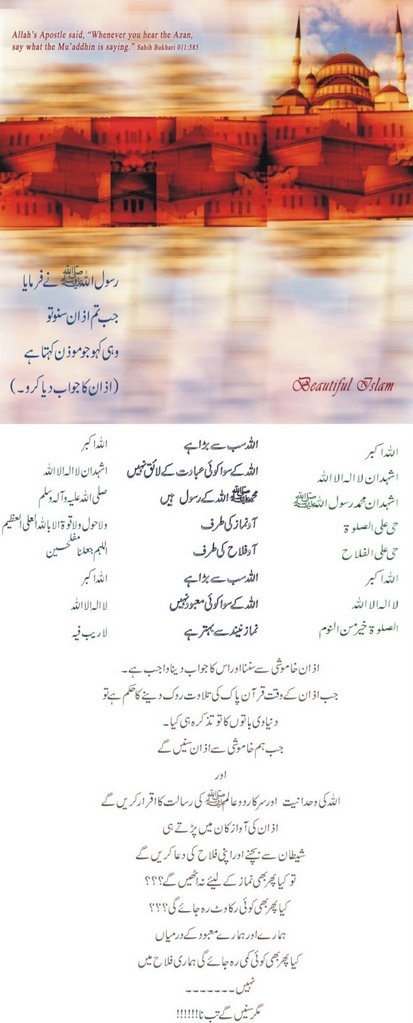
Sunday, November 26, 2006


Friday, November 17, 2006


Tuesday, November 14, 2006
malfoozat
KHANQA - E SHAIKH ZAKARIYYA - MALFOOZAT
The first and foremost intention that a Saalik must learn is "Innamal A’amolo bin Niyyah" i.e. Every action of yours is judged by the intention made for it.
Learn to do all your devotions solely for the pleasure of Allah Ta’ala.
Keep your devotions free from the bad Influences of show and insincerity.
Any action that is done to please Allah Ta’ala is always accepted and never rejected in the court of Allah Ta’ala.
Time, which we have missed, can never be recovered in our entire life.
When you remember Allah Ta’ala then shaytaan moves away from you but when you forget Allah Ta’ala then shaytaan comes and puts his evil influences into you.
If you want to be safeguarded from shaytaan and his evil influences then make Zikr of Allah Ta’ala.
Allah Ta’ala says in the holy Quraan’ And make Zikr of Allah Ta’ala and make that Zikr excessively.
Through the Zikr of Allah Ta’ala one may achieve recognition and Maarifat of Allah Ta’ala.
Nabi SaIIaIIahu Alaihi Wasalam has said that the greatest of action is the Zikr of Allah Ta’ala.
Our wealth and children will always try and keep us away from the remembrance of Allah Ta’ala.
Allah Ta’ala guides with His Noor whomsoever He wishes.
If we wish that Allah Ta’ala guides us with his Noor then let us spent our time in the remembrance of Allah Ta’ala.
Collect the Noor of Allah Ta’ala, for Noor is light.
The more attachment you have with Allah Ta’ala, the more Noor you will get.
The less attachment you have with Allah Ta’ala, the less Noor you will get.
When your heart becomes filled with the Noor of Allah Ta’ala then you will tread the path of Seeratul Mustakeem (path of Hidayyat).
Insaan can either be in Noor or in darkness.
Shaytaan always takes you out of Noor into darkness.
Evil gazes are very detrimental acts in removing the Noor from our hearts.
If you allow that Noor to leave you, than you are allowing the friendship of Allah Ta’ala to leave you.
Remember that every Sunnah is Noor.
Collect as much Noor as you desire by practising upon the Sunnah.
This Noor will definitely assist you in this world, at the time of death, in the Qabr as well as in the Aakirah.
Remember death daily 25 times by reciting’ 0 Allah bless me in death and bless me in the stages after death .
No matter how rich or poor we are, how healthy or sick we are, how pious or sinful we are, death will surely come to every one of us someday or another.
The constant remembrance of death will take our heart away from the glitter and glamour of this world.
The remembrance of death will turn your attention to the Aakhirat, wherein you are going to live forever.
Allah Ta’ala says in the Holy Quraan that’ Every soul shall taste of death .
Nobody knows when he is going to die.
Each one of us is going to lay in our own grave.
When you die, your Aamals end, you cannot do any more Aamals.
Do we know not that we are going to face Allah Ta’ala one day?
All the love that we have for this material world, we are going to leave behind.
The punishment in the grave is haq, it is true.
Let us learn to have patience in this world, for that patience is going to be of some assistance in the grave.
Fulfil every aspect of deen.
Jannah is a barren land, whatever good deeds you do in this world will fill that barren land of yours.
Either we spent our time in the devotion of Allah Ta’ala or in the disobedience of Allah Ta’ala, the choice is ours.
Jannat is going to be yours but you will have to work for it.
The first and foremost intention that a Saalik must learn is "Innamal A’amolo bin Niyyah" i.e. Every action of yours is judged by the intention made for it.
Learn to do all your devotions solely for the pleasure of Allah Ta’ala.
Keep your devotions free from the bad Influences of show and insincerity.
Any action that is done to please Allah Ta’ala is always accepted and never rejected in the court of Allah Ta’ala.
Time, which we have missed, can never be recovered in our entire life.
When you remember Allah Ta’ala then shaytaan moves away from you but when you forget Allah Ta’ala then shaytaan comes and puts his evil influences into you.
If you want to be safeguarded from shaytaan and his evil influences then make Zikr of Allah Ta’ala.
Allah Ta’ala says in the holy Quraan’ And make Zikr of Allah Ta’ala and make that Zikr excessively.
Through the Zikr of Allah Ta’ala one may achieve recognition and Maarifat of Allah Ta’ala.
Nabi SaIIaIIahu Alaihi Wasalam has said that the greatest of action is the Zikr of Allah Ta’ala.
Our wealth and children will always try and keep us away from the remembrance of Allah Ta’ala.
Allah Ta’ala guides with His Noor whomsoever He wishes.
If we wish that Allah Ta’ala guides us with his Noor then let us spent our time in the remembrance of Allah Ta’ala.
Collect the Noor of Allah Ta’ala, for Noor is light.
The more attachment you have with Allah Ta’ala, the more Noor you will get.
The less attachment you have with Allah Ta’ala, the less Noor you will get.
When your heart becomes filled with the Noor of Allah Ta’ala then you will tread the path of Seeratul Mustakeem (path of Hidayyat).
Insaan can either be in Noor or in darkness.
Shaytaan always takes you out of Noor into darkness.
Evil gazes are very detrimental acts in removing the Noor from our hearts.
If you allow that Noor to leave you, than you are allowing the friendship of Allah Ta’ala to leave you.
Remember that every Sunnah is Noor.
Collect as much Noor as you desire by practising upon the Sunnah.
This Noor will definitely assist you in this world, at the time of death, in the Qabr as well as in the Aakirah.
Remember death daily 25 times by reciting’ 0 Allah bless me in death and bless me in the stages after death .
No matter how rich or poor we are, how healthy or sick we are, how pious or sinful we are, death will surely come to every one of us someday or another.
The constant remembrance of death will take our heart away from the glitter and glamour of this world.
The remembrance of death will turn your attention to the Aakhirat, wherein you are going to live forever.
Allah Ta’ala says in the Holy Quraan that’ Every soul shall taste of death .
Nobody knows when he is going to die.
Each one of us is going to lay in our own grave.
When you die, your Aamals end, you cannot do any more Aamals.
Do we know not that we are going to face Allah Ta’ala one day?
All the love that we have for this material world, we are going to leave behind.
The punishment in the grave is haq, it is true.
Let us learn to have patience in this world, for that patience is going to be of some assistance in the grave.
Fulfil every aspect of deen.
Jannah is a barren land, whatever good deeds you do in this world will fill that barren land of yours.
Either we spent our time in the devotion of Allah Ta’ala or in the disobedience of Allah Ta’ala, the choice is ours.
Jannat is going to be yours but you will have to work for it.
Sunday, November 12, 2006

THE RAMADAN OF MAULANA RASHEED AHMAD GANGOHI
THE RAMADAN OF MAULANA RASHEED AHMAD GANGOHI
I have written in AAP BETI No 6 under the heading of spiritual exertion, that while dictating the practices of Hazrat Rasheed Ahmad Gangohi in Ramadan, I wanted to note it down because of its relevance to the subject. There I wrote:
“His extreme exertion in spiritual exercises were such that onlookers felt pity for him. Such was he that in Ramadan, even when his age had advanced beyond seventy, he fasted the whole day and then in Owabeen, instead of six rakats, he used to perform twenty rakats, during which he never recited less than approximately two paras. So long did he stay in ruku and sujood that onlookers thought that he had forgotten himself. On finishing this salaah, he proceeded homeward to partake of the evening meal. Even during this time too he would not remain idle, but en route and waiting for the food etc, he also finished reciting several paras.
Soon he would commence Esha salaah and taraweeh, which did not take less than an hour or an hour and a quarter at least. Thereafter he would lie down at about half past ten only to rise again at about two O’clock or half past two for tahajjud. At times his attendants and assistants found him performing wudoo at one O’clock. At this time of the night he used to spend 2-1/2 hours to three hours in tahajjud. Sometimes it happened that an attendant would go to him at five O’clock to join him for sehri and would find him in salaah.
After Fajr he remained busy reciting wazeefas, wirds and engrossed in meditation until eight O’clock or half past eight. Then it was time for Ishraq salaah. Thereafter for a few hours he would rest.
During this time the mail would arrive and he would begin answering letters and writing fatwas or dictate them. Thereafter it was time for Salatul-Duhaa (Chasht), and on performing this salaah, he would have his daytime sleep.
After Zuhr salaah he usually closed the door of his private room and busied himself with the recitation of the Quran until Asr time. Note that in the year for which this was his practices, he was suffering from extreme old age and various other sicknesses to such an extent that to walk from the toilet to his room - a mere fifteen paces - he became so tired that he had to sit down somewhere along the way to rest. In spite of this condition he never performed fard or nafl salaahs sitting down, but remained standing for hours. On several occasions attendants implored him: “Hazrat, today you should perform taraweeh from the sitting position. This seems quite appropriate.”
He always replied: “No! that is a sign of lack of courage and perseverance.”
All I can say is this that it is no easy task to be a true follower of him who is reported to have answered:
“Shall I then not be a grateful slave?”
During Ramadan there was a marked increase in his ibadat and exertion especially as far as his recitation of the Quran was concerned. Even when going to and from his house he never spoke. If an estimate of the total amount of his daily recitations in and out of salaah is made, it comes to about half a khatam of the Quran daily. On the morning of the first day of fasting he used to say:
“From today all noises of conversation shall cease. If any man allows Ramadan to be wasted, it is a great sorrow indeed.”
Now, what was his diet for such severe efforts? So little did he eat for the whole of Ramadan that the total of it all amounted to less than five 'seer’ (5kg) of grain. In his biography - “TAZKIRA-E-RASHEED” written by the successor (khalifa) of the Imam Rabbani, Hakeem Is-haq Saheb, his Ramadan habits are discussed:
“During Ramadan he used to emerge from his private resting place late in the morning. In summer he generally came out about ten O’clock because he used to greatly increase his nafl salah, tilawat of the Quran, his moments of silence and meditation as compared with other months. In this time he slept very little, spoke very little, only retiring after Maghrib for a while to eat something. Initially he himself used to lead all twenty raka-’ah s of taraweeh salaah and later performed it behind his son, Hafiz Hakeem Muhammad
Mas’ood Saheb. After that he performed two long raka-’ahs of nafl salaah, sometimes standing up and sometimes sitting down, thereafter remaining seated for a long time facing the Qibla and reciting. Thereafter he performed one sajdah-e-tilawat and stood up. From hearing some of the word he recited softly, I deduced that he recited Surah Mulk, Surah Sajdah and Surah Dukhaan.
He usually fasted the ten days of Zi1 Haj, the days of Ashura and the middle of Sha’baan.”
TAZKIRA-E-RASHEED
My late father on many occasions told the following story:
“During Hazrat’s last Ramadan I led the taraweeh prayers (for him and his attendants). It so happened that because of some reason or other, Hazrat’s son, Hakeem Muhammad Mas’ood was unable to perform it.”
For quite some days before the commencement of Ramadan Hazrat said:
“Mas’ood Ahmad Saheb is indisposed and not available to lead taraweeh prayers. Who is going to recite the Quran for us in Taraweeh?”
On every occasion I wanted to offer my services and declare my readiness, but out of respect I refrained from doing so. Two days before Ramadan Hazrat said:
“Moulvi Yahya Saheb, you are also a hafiz of the Quran?”
I replied: Yes Hazrat, I am indeed. But I recite the Quran in a Persian tone. You are used to hearing the recitation of Hakeem Mas’ood Ahmad Saheb, who is indeed a fine Qari.”
Hazrat replied: “No, I have already heard your recitation. You shall lead in taraweeh.”
My father says: “On the first day it was a great burden for me. By way of preparation, I had to recite one and a quarter para of the Quran by looking into the Quran. I had memorised the Quran at the age of seven. Thereafter for six months I had to look into the Quran and daily recite one full khatam. And since then I have never looked into the Quran to recite it. The first day, in order to prepare myself properly, I recited 1-1/4 paras from the Quran, but from the second day onwards the fear, nervousness and anxiety disappeared. Thereafter there was no further need to look into the Quran.”
My late father (May Allah fill his resting place with noor) was indeed a very good hafiz with tremendous energy to recite the Quran by heart. He had a bookshop where he himself made up the parcels to be posted, and wrote the addresses himself. While doing that he was all the time reciting the Quran in audible fashion without ever becoming confused or struggling over the ‘mutashaabihaat’.
Maulana ‘Ashiq Ilahi writes about him in “TAZKIRA-E-KHALEEL’:
“Once upon my request he was invited to Meerut to lead taraweeh prayers and recite the Quran in Ramadan. I saw that wherever he went, he was all the time busy reciting by himself so that he finished a whole khatam daily. When it was time for Iftar, he was reading: “Qul a’oothu bi rabbinnaas...”
When he arrived by rail at Meerut it was Esha time. Being a man who was continuously in a state of wudoo, he entered the mosque and immediately proceeded to the musallah to lead the prayers and in three hours recited ten paras so clearly, without any struggling over difficult patches as if the Quran was an open book in front of him. So comfortable was his pace of recitation, that he completed a full khatam of the Quran in three nights and departed. So good a hafiz was he that there was no need to revise his reading beforehand; neither was there any need for someone to stand behind him and listen with a view to correct if needed.”
My father also used to say about this visit to Meerut: “When the word got around in Meerut that a certain man was coming to complete a full khatam of the Quran in salaah within three days, thirty or fourty hafizes arrived from far and wide to stand behind him and test him.”
My late father never had trouble with fever in Ramadan like myself. On the invitations and insistence of friends, he often went to their places to finish a khatam in two or at the most three nights before returning home. In mosques he generally did it in three nights and in other ibadat-khanas he generally did so in two or even in one night. Once on the invitation of the late Shah ZAHID HUSSAIN he completed a khatam at Shah Saheb’s house in two nights.
I can still remember his recitation in the Nawab-wali Masjid in Qasaabpura, Delhi. A certain Moulvi Naseeruddin was busy performing taraweeh in the Hakeem Ishaq Masjid. At that time my father arrived in Delhi from somewhere. He went to rest a little in the resting place of Hakeem Ishaq attached to the Masjid. It so happened that Moulvi Naseeruddin was reciting the 14th para and making heavy weather, so that he had to be corrected time and again. My father went into the Masjid and as soon as Moulvi Naseeruddin gave the next salaam, he asked him to vacate the spot, and he himself took over. In the next sixteen rakaats he recited sixteen paras. No doubt, the musallis must have found the going tiring and exhausting. But it is a fact that people are more pleased with finishing the Quran quickly than they are worried about a bit of hardship. To have been able to finish the Quran on the 12th night made them forget their exhaustion.
I can also remember his recitation of the Quran in the house of Ummi Bi in Kandhla. She is Amatur Rahman, the daughter of Maulana Muzaffar Hussain, my father’s maternal grandmother who became known as Ummi Bi. In answer to a special request he remained reciting the Quran throughout the night in nafl prayers. Because of the fact that according to us (Hanafis) it is not permissible to have more than four muqtadees in nafl prayers, the ladies behind him had to be changed continuously, while my father continued reciting.
My late uncle (Maulana Ilyaas) also used to visit Kandhla in Ramadan because of the presence there of Ummi Bi. At such times the Quran khatam used to be completed in about one single night. At such times he performed Esha salaah in the Masjid and thereafter go to the house of Ummi Bi to perform taraweeh there from after Esha until sehri time, thereby completing fourteen or fifteen paras. Maulana Raooful Hasan Saheb is the uncle of my late father and the father of my late wife. His story has already been mentioned in ‘AAP BETI’ under the heading: TAQWA. On the 30th Ramadan he recited from Alif Laam Meem until Qul a-’oothu bi rabbil falaq... in one single raka-’ah and in the second raka-’ah he recited only Surah ... al Naas! Then at sehri time he told his mother Ummi bi:
“I have now performed two raka-’aha. Will you now perform the other eighteen?”
During all that time the mother listened to the Quran while standing, behind him in the salaah!
I have written in AAP BETI No 6 under the heading of spiritual exertion, that while dictating the practices of Hazrat Rasheed Ahmad Gangohi in Ramadan, I wanted to note it down because of its relevance to the subject. There I wrote:
“His extreme exertion in spiritual exercises were such that onlookers felt pity for him. Such was he that in Ramadan, even when his age had advanced beyond seventy, he fasted the whole day and then in Owabeen, instead of six rakats, he used to perform twenty rakats, during which he never recited less than approximately two paras. So long did he stay in ruku and sujood that onlookers thought that he had forgotten himself. On finishing this salaah, he proceeded homeward to partake of the evening meal. Even during this time too he would not remain idle, but en route and waiting for the food etc, he also finished reciting several paras.
Soon he would commence Esha salaah and taraweeh, which did not take less than an hour or an hour and a quarter at least. Thereafter he would lie down at about half past ten only to rise again at about two O’clock or half past two for tahajjud. At times his attendants and assistants found him performing wudoo at one O’clock. At this time of the night he used to spend 2-1/2 hours to three hours in tahajjud. Sometimes it happened that an attendant would go to him at five O’clock to join him for sehri and would find him in salaah.
After Fajr he remained busy reciting wazeefas, wirds and engrossed in meditation until eight O’clock or half past eight. Then it was time for Ishraq salaah. Thereafter for a few hours he would rest.
During this time the mail would arrive and he would begin answering letters and writing fatwas or dictate them. Thereafter it was time for Salatul-Duhaa (Chasht), and on performing this salaah, he would have his daytime sleep.
After Zuhr salaah he usually closed the door of his private room and busied himself with the recitation of the Quran until Asr time. Note that in the year for which this was his practices, he was suffering from extreme old age and various other sicknesses to such an extent that to walk from the toilet to his room - a mere fifteen paces - he became so tired that he had to sit down somewhere along the way to rest. In spite of this condition he never performed fard or nafl salaahs sitting down, but remained standing for hours. On several occasions attendants implored him: “Hazrat, today you should perform taraweeh from the sitting position. This seems quite appropriate.”
He always replied: “No! that is a sign of lack of courage and perseverance.”
All I can say is this that it is no easy task to be a true follower of him who is reported to have answered:
“Shall I then not be a grateful slave?”
During Ramadan there was a marked increase in his ibadat and exertion especially as far as his recitation of the Quran was concerned. Even when going to and from his house he never spoke. If an estimate of the total amount of his daily recitations in and out of salaah is made, it comes to about half a khatam of the Quran daily. On the morning of the first day of fasting he used to say:
“From today all noises of conversation shall cease. If any man allows Ramadan to be wasted, it is a great sorrow indeed.”
Now, what was his diet for such severe efforts? So little did he eat for the whole of Ramadan that the total of it all amounted to less than five 'seer’ (5kg) of grain. In his biography - “TAZKIRA-E-RASHEED” written by the successor (khalifa) of the Imam Rabbani, Hakeem Is-haq Saheb, his Ramadan habits are discussed:
“During Ramadan he used to emerge from his private resting place late in the morning. In summer he generally came out about ten O’clock because he used to greatly increase his nafl salah, tilawat of the Quran, his moments of silence and meditation as compared with other months. In this time he slept very little, spoke very little, only retiring after Maghrib for a while to eat something. Initially he himself used to lead all twenty raka-’ah s of taraweeh salaah and later performed it behind his son, Hafiz Hakeem Muhammad
Mas’ood Saheb. After that he performed two long raka-’ahs of nafl salaah, sometimes standing up and sometimes sitting down, thereafter remaining seated for a long time facing the Qibla and reciting. Thereafter he performed one sajdah-e-tilawat and stood up. From hearing some of the word he recited softly, I deduced that he recited Surah Mulk, Surah Sajdah and Surah Dukhaan.
He usually fasted the ten days of Zi1 Haj, the days of Ashura and the middle of Sha’baan.”
TAZKIRA-E-RASHEED
My late father on many occasions told the following story:
“During Hazrat’s last Ramadan I led the taraweeh prayers (for him and his attendants). It so happened that because of some reason or other, Hazrat’s son, Hakeem Muhammad Mas’ood was unable to perform it.”
For quite some days before the commencement of Ramadan Hazrat said:
“Mas’ood Ahmad Saheb is indisposed and not available to lead taraweeh prayers. Who is going to recite the Quran for us in Taraweeh?”
On every occasion I wanted to offer my services and declare my readiness, but out of respect I refrained from doing so. Two days before Ramadan Hazrat said:
“Moulvi Yahya Saheb, you are also a hafiz of the Quran?”
I replied: Yes Hazrat, I am indeed. But I recite the Quran in a Persian tone. You are used to hearing the recitation of Hakeem Mas’ood Ahmad Saheb, who is indeed a fine Qari.”
Hazrat replied: “No, I have already heard your recitation. You shall lead in taraweeh.”
My father says: “On the first day it was a great burden for me. By way of preparation, I had to recite one and a quarter para of the Quran by looking into the Quran. I had memorised the Quran at the age of seven. Thereafter for six months I had to look into the Quran and daily recite one full khatam. And since then I have never looked into the Quran to recite it. The first day, in order to prepare myself properly, I recited 1-1/4 paras from the Quran, but from the second day onwards the fear, nervousness and anxiety disappeared. Thereafter there was no further need to look into the Quran.”
My late father (May Allah fill his resting place with noor) was indeed a very good hafiz with tremendous energy to recite the Quran by heart. He had a bookshop where he himself made up the parcels to be posted, and wrote the addresses himself. While doing that he was all the time reciting the Quran in audible fashion without ever becoming confused or struggling over the ‘mutashaabihaat’.
Maulana ‘Ashiq Ilahi writes about him in “TAZKIRA-E-KHALEEL’:
“Once upon my request he was invited to Meerut to lead taraweeh prayers and recite the Quran in Ramadan. I saw that wherever he went, he was all the time busy reciting by himself so that he finished a whole khatam daily. When it was time for Iftar, he was reading: “Qul a’oothu bi rabbinnaas...”
When he arrived by rail at Meerut it was Esha time. Being a man who was continuously in a state of wudoo, he entered the mosque and immediately proceeded to the musallah to lead the prayers and in three hours recited ten paras so clearly, without any struggling over difficult patches as if the Quran was an open book in front of him. So comfortable was his pace of recitation, that he completed a full khatam of the Quran in three nights and departed. So good a hafiz was he that there was no need to revise his reading beforehand; neither was there any need for someone to stand behind him and listen with a view to correct if needed.”
My father also used to say about this visit to Meerut: “When the word got around in Meerut that a certain man was coming to complete a full khatam of the Quran in salaah within three days, thirty or fourty hafizes arrived from far and wide to stand behind him and test him.”
My late father never had trouble with fever in Ramadan like myself. On the invitations and insistence of friends, he often went to their places to finish a khatam in two or at the most three nights before returning home. In mosques he generally did it in three nights and in other ibadat-khanas he generally did so in two or even in one night. Once on the invitation of the late Shah ZAHID HUSSAIN he completed a khatam at Shah Saheb’s house in two nights.
I can still remember his recitation in the Nawab-wali Masjid in Qasaabpura, Delhi. A certain Moulvi Naseeruddin was busy performing taraweeh in the Hakeem Ishaq Masjid. At that time my father arrived in Delhi from somewhere. He went to rest a little in the resting place of Hakeem Ishaq attached to the Masjid. It so happened that Moulvi Naseeruddin was reciting the 14th para and making heavy weather, so that he had to be corrected time and again. My father went into the Masjid and as soon as Moulvi Naseeruddin gave the next salaam, he asked him to vacate the spot, and he himself took over. In the next sixteen rakaats he recited sixteen paras. No doubt, the musallis must have found the going tiring and exhausting. But it is a fact that people are more pleased with finishing the Quran quickly than they are worried about a bit of hardship. To have been able to finish the Quran on the 12th night made them forget their exhaustion.
I can also remember his recitation of the Quran in the house of Ummi Bi in Kandhla. She is Amatur Rahman, the daughter of Maulana Muzaffar Hussain, my father’s maternal grandmother who became known as Ummi Bi. In answer to a special request he remained reciting the Quran throughout the night in nafl prayers. Because of the fact that according to us (Hanafis) it is not permissible to have more than four muqtadees in nafl prayers, the ladies behind him had to be changed continuously, while my father continued reciting.
My late uncle (Maulana Ilyaas) also used to visit Kandhla in Ramadan because of the presence there of Ummi Bi. At such times the Quran khatam used to be completed in about one single night. At such times he performed Esha salaah in the Masjid and thereafter go to the house of Ummi Bi to perform taraweeh there from after Esha until sehri time, thereby completing fourteen or fifteen paras. Maulana Raooful Hasan Saheb is the uncle of my late father and the father of my late wife. His story has already been mentioned in ‘AAP BETI’ under the heading: TAQWA. On the 30th Ramadan he recited from Alif Laam Meem until Qul a-’oothu bi rabbil falaq... in one single raka-’ah and in the second raka-’ah he recited only Surah ... al Naas! Then at sehri time he told his mother Ummi bi:
“I have now performed two raka-’aha. Will you now perform the other eighteen?”
During all that time the mother listened to the Quran while standing, behind him in the salaah!

Saturday, November 11, 2006
Hazrat Haji Imdadullah Muhajir Makki Saheb RH
Shaykh Haji Imdadullah Muhajir Makki (Rahmatullahi Alayhi) (1233 AH – 1317AH) (1814 Ad – 1896 AD)
Haji Imdadullah Muhajir Makki (Rahmatullahi Alayhi) was such a great personality that the title given to him by his contemporary Ulama was “Sheikhul Mashaikh” which means the leader of leaders. His personality was well respected by the Ulama of the sub continent India and Pakistan and also by the Arab Ulama. That is why his title was also Sheikhul Arab wa Ajam (the leader of the Arabs and non-Arabs). Haji Sahib’s background and education Haji Imdadullah Muhaajir Makki (Rahmatullahi Alayhi) was born in 1233 AH (1814 AD) in Nanota, a town in the district of Saharanpur, India U.P. He father was Hafiz Muhammad Amin (Rahmatullahi Alayhi) and by lineage and ancestral background, Haji Imdadullah Muhajir Makki (Rahmatullahi Alayhi) was a Farooqi, a descendent of Hadhrat Umar Farooq (Radiyallahu anhu). When he was born, his father Hafiz Muhammad Amin (Rahmatullahi Alayhi) kept his son’s name Imdad Hussein. When the famous Muhaddith, Shah Muhammad Ishaaq Sahib (Rahmatullahi Alayhi) heard this name, he didn’t like it and he changed the name to Imdadullah. Imdad Hussein means the assistance of Hussein. All assistance comes from Allah. So there was a form of shirk in this name. Haji Imdadullah Muhajir Makki (Rahmatullahi Alayhi) also used to attribute the name Khuda Bakhsh to himself. Some say his name was Imdadullah and others say his name was Khuda Bakhsh (gifted by Allah). Both names are close in meaning. In some places Haji Sahib calls himself Abdul Kareem (the slave of Kareem). Haji Imdadullah Muhajir Makki (Rahmatullahi Alayhi) had three brothers and one sister. He grew up without motherly care as his mother passed away when he was seven years old. Haji Imdadullah Muhajir Makki (Rahmatullahi Alayhi) started his education very early but he acquired very little education. When Haji Sahib was 16 years of age, he studied Sarf, Nahw, Farsi and one quarter of Mishkaat Shareef by Maulana Mamlook Ali Sahib (Rahmatullahi Alayhi) of Delhi. Haji Imdadullah Muhajir Makki didn’t study Bukhari and the other books of Sihah Sitta, but Allah Ta’ala blessed Haji Imdadullah Muhajir Makki (Rahmatullahi Alayhi) with Ilm Ladunni. One is that knowledge that a person acquires. He studies different subjects and books. Another form of knowledge is from Allah Ta’ala without studying. When Haji Imdadullah Muhajir Makki (Rahmatullahi Alayhi) would talk to the Ulama, he would resolve such intricate issues with the insight that Allah Ta’ala had given him. However, he would not use the Istilaahi language (academic terminologies). This is Ilm La Dunni. When he was 18 years of age he took bayat upon the hands of Maulana Naseeruddin Sahib (Rahmatullahi Alayhi) who was the student and son-in-law of Shah Ishaaq Sahib (Rahmatullahi Alayhi). When Maulana Naseeruddin Sahib (Rahmatullahi Alayhi) passed away, Haji Imdadullah Muhajir Makki (Rahmatullahi Alayhi) was looking for another person to give him guidance and advice in life. This is where we learn of the famous Sheikh and the spiritual guide, Hadhrat Maulana Mayanji Noor Muhammad (Rahmatullahi Alayhi). Haji Sahib took bayat on his hands. At the age of 28, Haji Imdadullah (Rahmatullahi Alayhi) performed Hajj. When he returned after Hajj, his heart and mind remained attached to the Haram Shareef. He had a burning desire to return to Makkah Mukarramah. When he returned from Hajj, he made a firm intention that one day he will make Hijrah and go back to Makkah Mukarramah. Haji Imdadullah Muhajir Makki (Rahmatullahi Alayhi) came back to his town in a place near Thanabawan. Maulana Qasim Nanotwi (Rahmatullahi Alayhi), Maulana Rashid Ahmad Gangohi (Rahmatullahi Alayhi), and other great Ulama used to frequent Haji Imdadullah Muhajir Makki (Rahmatullahi Alayhi) and they had taken Bayat on his hands. Generally when one hears of these Ulama, Haji Imdadullah Muhajir Makki (Rahmatullahi Alayhi), Maulana Qasim Nanotwi (Rahmatullahi Alayhi), Maulana Rashid Ahmad Gangohi (Rahmatullahi Alayhi), one would think that these were great saints just sitting in the corner of a Musjid. That was not the case. These were personalities that had complete E’tidal (moderation) in their life. Hardships whilst in Makkah Mukarramah When he reached Makkah Mukarramah he had much difficulty. For nine days he had no food at all. He only lived on Zamzam water. He became extremely weak. When it was the tenth day he requested help from people he knew but no one assisted him until one person came and gave him 100 riyals. From that month on, every month of his life, he used to get 100 riyals. He never suffered after that for his needs. Allah arranges for his pious slaves in strange ways. There is an incident of four Mohammads who were experts in Hadith and Tafseer; Muhammad ibn Jareer Tabri, Mohammad ibn Haroon, Mohammad ibn Nasaf and Mohammad ibn Ishaaq. These four Mohammads were traveling and became stranded. They conducted a raffle among themselves for the person who will be responsible to arrange for food. The name of Mohammad ibn Ishaaq came out. Mohammad ibn Ishaaq never spread his hands before anybody. So he engaged himself in salaah. Suddenly, one person tapped at the door and he asked for Mohammad ibn Jareer. The person then presented fifty riyals for him on behalf of the governor of Egypt. He took the name of Mohammad ibn Haroon and presented fifty riyals for him. He gave Mohammad ibn Nasaf Zafar fifty riyals. He also gave Mohammad ibn Ishaaq fifty riyals. Then he said that the governor of Egypt was sleeping and in his sleep he was ordered to assist four Mohammads that are stranded. Haji Imdadullah (Rahmatullahi Alayhi) was also stranded. He says that he knew that this was a test from the side of Allah. If you love the Haram Shareef, you have to undergo difficulties and hardships, so you pay the price to be there. Haji Sahib became very popular in the Arab world. There were approximately 500 or more Ulama who have taken bayat upon the hands of Haji Imdadullah Sahib (Rahmatullahi Alayhi). Not one Alim, 10 Alims or 100 but 500 Ulama. When we look at the lives of the Akaabir we don’t find so many Ulama who have taken bayat upon somebody who outwardly and apparently has very little traditional knowledge. Some special qualities of Haji Sahib One very outstanding quality of Haji Sahib was that he was a person who was very facilitating and very tolerant. That is why in his majlis people who didn’t subscribe to Ahle Sunnat wa Jammat used to attend Haji Sahib’s majlis (gathering). Haji sahib never picked on them. His only concern was Islah and to take the people and make them closer to Allah. Once, a ghayr muqallid who used to make Raful yadain and Ameen bil Jahr took bayat with Haji sahib. The moment he took bayat he stopped raful Yadain and Ameen bil Jahr. Haji Sahib called him and said to him, “Before this you were making Raful Yadain and Ameen bil Jahr, why did you stop?” “Because you took bayat on my hands?” “Brother, if you stopped that because you took bayat on my hands, then don’t do that because that is also proven from the hadith. So if you stopped it because of me then you carry on doing that. But if you stopped it on your own and not because you have taken bayat upon my hands, then I understand.” (as this is the correct thing to do). Another person who was very close to Haji Sahib (Rahmatullahi Alayhi) was Maulana Rahmatullah Kiranwi (Rahmatullahi Alayhi). He was a very powerful orator. The British were also looking for him. He also escaped and reached Makkah Mukarramah with Haji Sahib. Ahmad Deedat (Rahmatullahi Alayhi) benefited from the book Izhaarul Haqq of Maulana Rahmatullah Kiranwi (Rahmatullahi Alayhi). There is a Madressah named Madressah Saulatiyyah in Makkah Mukarramah. Saulatiyyah is derived from the word Saulat. When Maulana was going to Makkah Mukarramah he requested some people for help to establish a Madressah in Makkah Mukarramah. So one woman from Calcutta, Saulat, gave money. Maulana established the Madressah in Makkah Mukarramah with her money and that is why the Madressah is named Saulatiyyah. Maulana Rahmatullah Kiranwi (Rahmatullahi Alayhi) stayed very close to Haji Sahib in Makkah Mukarramah and that is where both of them passed away. Marriages and demise of Haji Sahib Haji Sahib married at the very old age of 55. He married three times. The first wife passed away. The second wife was blind. The third was a woman who wanted to make his khidmat (serve him). But, all his marriages were in old age and he only married with this intention that you can’t be a true Wali of Allah until you don’t make Nikah. Haji Sahib passed away in 1317 AH (1896 AD) at the ripe old age of 84. In his inheritance he had one stick, two sets of winter clothes and two sets of summer clothes. Haji Sahib is buried in Makkah Mukarramah in Jannatul Maala. May Allah Ta’ala elevate the status of Haji Sahib. Ameen.
Haji Imdadullah Muhajir Makki (Rahmatullahi Alayhi) was such a great personality that the title given to him by his contemporary Ulama was “Sheikhul Mashaikh” which means the leader of leaders. His personality was well respected by the Ulama of the sub continent India and Pakistan and also by the Arab Ulama. That is why his title was also Sheikhul Arab wa Ajam (the leader of the Arabs and non-Arabs). Haji Sahib’s background and education Haji Imdadullah Muhaajir Makki (Rahmatullahi Alayhi) was born in 1233 AH (1814 AD) in Nanota, a town in the district of Saharanpur, India U.P. He father was Hafiz Muhammad Amin (Rahmatullahi Alayhi) and by lineage and ancestral background, Haji Imdadullah Muhajir Makki (Rahmatullahi Alayhi) was a Farooqi, a descendent of Hadhrat Umar Farooq (Radiyallahu anhu). When he was born, his father Hafiz Muhammad Amin (Rahmatullahi Alayhi) kept his son’s name Imdad Hussein. When the famous Muhaddith, Shah Muhammad Ishaaq Sahib (Rahmatullahi Alayhi) heard this name, he didn’t like it and he changed the name to Imdadullah. Imdad Hussein means the assistance of Hussein. All assistance comes from Allah. So there was a form of shirk in this name. Haji Imdadullah Muhajir Makki (Rahmatullahi Alayhi) also used to attribute the name Khuda Bakhsh to himself. Some say his name was Imdadullah and others say his name was Khuda Bakhsh (gifted by Allah). Both names are close in meaning. In some places Haji Sahib calls himself Abdul Kareem (the slave of Kareem). Haji Imdadullah Muhajir Makki (Rahmatullahi Alayhi) had three brothers and one sister. He grew up without motherly care as his mother passed away when he was seven years old. Haji Imdadullah Muhajir Makki (Rahmatullahi Alayhi) started his education very early but he acquired very little education. When Haji Sahib was 16 years of age, he studied Sarf, Nahw, Farsi and one quarter of Mishkaat Shareef by Maulana Mamlook Ali Sahib (Rahmatullahi Alayhi) of Delhi. Haji Imdadullah Muhajir Makki didn’t study Bukhari and the other books of Sihah Sitta, but Allah Ta’ala blessed Haji Imdadullah Muhajir Makki (Rahmatullahi Alayhi) with Ilm Ladunni. One is that knowledge that a person acquires. He studies different subjects and books. Another form of knowledge is from Allah Ta’ala without studying. When Haji Imdadullah Muhajir Makki (Rahmatullahi Alayhi) would talk to the Ulama, he would resolve such intricate issues with the insight that Allah Ta’ala had given him. However, he would not use the Istilaahi language (academic terminologies). This is Ilm La Dunni. When he was 18 years of age he took bayat upon the hands of Maulana Naseeruddin Sahib (Rahmatullahi Alayhi) who was the student and son-in-law of Shah Ishaaq Sahib (Rahmatullahi Alayhi). When Maulana Naseeruddin Sahib (Rahmatullahi Alayhi) passed away, Haji Imdadullah Muhajir Makki (Rahmatullahi Alayhi) was looking for another person to give him guidance and advice in life. This is where we learn of the famous Sheikh and the spiritual guide, Hadhrat Maulana Mayanji Noor Muhammad (Rahmatullahi Alayhi). Haji Sahib took bayat on his hands. At the age of 28, Haji Imdadullah (Rahmatullahi Alayhi) performed Hajj. When he returned after Hajj, his heart and mind remained attached to the Haram Shareef. He had a burning desire to return to Makkah Mukarramah. When he returned from Hajj, he made a firm intention that one day he will make Hijrah and go back to Makkah Mukarramah. Haji Imdadullah Muhajir Makki (Rahmatullahi Alayhi) came back to his town in a place near Thanabawan. Maulana Qasim Nanotwi (Rahmatullahi Alayhi), Maulana Rashid Ahmad Gangohi (Rahmatullahi Alayhi), and other great Ulama used to frequent Haji Imdadullah Muhajir Makki (Rahmatullahi Alayhi) and they had taken Bayat on his hands. Generally when one hears of these Ulama, Haji Imdadullah Muhajir Makki (Rahmatullahi Alayhi), Maulana Qasim Nanotwi (Rahmatullahi Alayhi), Maulana Rashid Ahmad Gangohi (Rahmatullahi Alayhi), one would think that these were great saints just sitting in the corner of a Musjid. That was not the case. These were personalities that had complete E’tidal (moderation) in their life. Hardships whilst in Makkah Mukarramah When he reached Makkah Mukarramah he had much difficulty. For nine days he had no food at all. He only lived on Zamzam water. He became extremely weak. When it was the tenth day he requested help from people he knew but no one assisted him until one person came and gave him 100 riyals. From that month on, every month of his life, he used to get 100 riyals. He never suffered after that for his needs. Allah arranges for his pious slaves in strange ways. There is an incident of four Mohammads who were experts in Hadith and Tafseer; Muhammad ibn Jareer Tabri, Mohammad ibn Haroon, Mohammad ibn Nasaf and Mohammad ibn Ishaaq. These four Mohammads were traveling and became stranded. They conducted a raffle among themselves for the person who will be responsible to arrange for food. The name of Mohammad ibn Ishaaq came out. Mohammad ibn Ishaaq never spread his hands before anybody. So he engaged himself in salaah. Suddenly, one person tapped at the door and he asked for Mohammad ibn Jareer. The person then presented fifty riyals for him on behalf of the governor of Egypt. He took the name of Mohammad ibn Haroon and presented fifty riyals for him. He gave Mohammad ibn Nasaf Zafar fifty riyals. He also gave Mohammad ibn Ishaaq fifty riyals. Then he said that the governor of Egypt was sleeping and in his sleep he was ordered to assist four Mohammads that are stranded. Haji Imdadullah (Rahmatullahi Alayhi) was also stranded. He says that he knew that this was a test from the side of Allah. If you love the Haram Shareef, you have to undergo difficulties and hardships, so you pay the price to be there. Haji Sahib became very popular in the Arab world. There were approximately 500 or more Ulama who have taken bayat upon the hands of Haji Imdadullah Sahib (Rahmatullahi Alayhi). Not one Alim, 10 Alims or 100 but 500 Ulama. When we look at the lives of the Akaabir we don’t find so many Ulama who have taken bayat upon somebody who outwardly and apparently has very little traditional knowledge. Some special qualities of Haji Sahib One very outstanding quality of Haji Sahib was that he was a person who was very facilitating and very tolerant. That is why in his majlis people who didn’t subscribe to Ahle Sunnat wa Jammat used to attend Haji Sahib’s majlis (gathering). Haji sahib never picked on them. His only concern was Islah and to take the people and make them closer to Allah. Once, a ghayr muqallid who used to make Raful yadain and Ameen bil Jahr took bayat with Haji sahib. The moment he took bayat he stopped raful Yadain and Ameen bil Jahr. Haji Sahib called him and said to him, “Before this you were making Raful Yadain and Ameen bil Jahr, why did you stop?” “Because you took bayat on my hands?” “Brother, if you stopped that because you took bayat on my hands, then don’t do that because that is also proven from the hadith. So if you stopped it because of me then you carry on doing that. But if you stopped it on your own and not because you have taken bayat upon my hands, then I understand.” (as this is the correct thing to do). Another person who was very close to Haji Sahib (Rahmatullahi Alayhi) was Maulana Rahmatullah Kiranwi (Rahmatullahi Alayhi). He was a very powerful orator. The British were also looking for him. He also escaped and reached Makkah Mukarramah with Haji Sahib. Ahmad Deedat (Rahmatullahi Alayhi) benefited from the book Izhaarul Haqq of Maulana Rahmatullah Kiranwi (Rahmatullahi Alayhi). There is a Madressah named Madressah Saulatiyyah in Makkah Mukarramah. Saulatiyyah is derived from the word Saulat. When Maulana was going to Makkah Mukarramah he requested some people for help to establish a Madressah in Makkah Mukarramah. So one woman from Calcutta, Saulat, gave money. Maulana established the Madressah in Makkah Mukarramah with her money and that is why the Madressah is named Saulatiyyah. Maulana Rahmatullah Kiranwi (Rahmatullahi Alayhi) stayed very close to Haji Sahib in Makkah Mukarramah and that is where both of them passed away. Marriages and demise of Haji Sahib Haji Sahib married at the very old age of 55. He married three times. The first wife passed away. The second wife was blind. The third was a woman who wanted to make his khidmat (serve him). But, all his marriages were in old age and he only married with this intention that you can’t be a true Wali of Allah until you don’t make Nikah. Haji Sahib passed away in 1317 AH (1896 AD) at the ripe old age of 84. In his inheritance he had one stick, two sets of winter clothes and two sets of summer clothes. Haji Sahib is buried in Makkah Mukarramah in Jannatul Maala. May Allah Ta’ala elevate the status of Haji Sahib. Ameen.
Friday, November 10, 2006
for sufis
1. A sinner who repents is nobler than a man whose worship is followed by pride. 2. The sign of the heart enjoying a connection with Allah Ta'ala is the heart's inability to find enjoyment in any relationship of the world. 3. Sleep with maut under your pillow and when you arise do not have much hope in life. 4. Never consider sin to be small. Regard sin as great. He who thinks slightly of sin has considered Allah to be insignificant. 5. Guard the nafs at all times. 6. Abstention from sin is of greater importance than Ibaadat. 7. A little of Halaal earnings is superior to earnings which are in abundance, but haraam. Respect is in contentment and comfort in abstention. 8. A strong Sabr is to be pleased with one's lot. 9. Courage is to acquire the knowledge of the Deen. Perfect practice is that which is accompanied by Ikhlaas (sincerity). 10. It is of the acts of courage that one acquires the knowledge of the Deen; practice perfectly with sincerity, and be fully contented and adopt beautiful patience. 11. A sheep is nobler than a man who sacrifices the commands of Allah for the sake of his desire, for the call of the shepherd is heard by the sheep. 12. The association of the pious is better than acts of piety and the association of the evil is worse than acts of evil. 13. The non-existence of even a grain of vanity and falsehood in one is an aspect of Ma'rifat. 14. The look cast without the intention of gaining admonition and lesson is total neglect and a medium of disgrace. Freedom is obtained by trampling the desires of the nafs underfoot. Elimination of envy occasions the love of Allah. 15. When speaking, speak the truth whether in anger or in happiness. 16. Three persons depart with regret at the time of death. A man who spent his life accumulating wealth without having realized contentment. A man who did not obtain what he had wished for. A man who did not prepare his stock for the Hereafter. 17. Abstain from the companionship of a friend who causes you no benefit of the Aakhirah. The friendship of worldly people is like something which has beautiful colour but bad taste. Hadhrat Hasan (Rahmatullah Alayh)said: "Never listen to music no matter what rank you have attained." 18. The knowledge of a man who prefers conversation with people to remembrance of Allah, is little; his heart is blind and his life is wasted. 19. The lowest degree of harm which befalls a man who befriends the world is that Allah Ta'ala eliminates the pleasure of His remembrance and supplication from his heart. 20. Shaitaan does not bother about the one who in this world is a seeker of the pleasure of the nafs because such a person has himself gone astray. What purpose then has shaitaan to search for him? 21. Hadhrat Shaikh Muhammad Waasi' (Rahmatullah Alayh) was among the very greatest Auliyaa. A man requested Naseehat of him. The Shaikh said: "I will give you such Naseehat by means of which you may become the king of the world, and obtain peace in the Aakhirah. Adopt zuhd (abstention) in this world. Never have any greed or hope regarding any man. Regard all creation to be dependant on Allah. It is then evident that you will become independent of all. This is the meaning of becoming a king." 22. Ruin comes to a person from six avenues. Weakness of intention regarding the acts of the Aakhirah. Obedience to the commands of shaitaan and striving in that direction. Inspite of nearness of death, to entertain distant hopes and plans. To adopt the pleasure of people in preference to the Pleasure of Allah. To abstain from the Sunnah of Rasulullah Sallallahu alayhi wasallam because of obedience to the desires of the nafs. To cite the errors of previous Auliyaa as proof for one's acts and to bury their excellences. 23. The sign of love for Allah Ta'ala is that one follows the character, acts, laws and ways of the beloved of Allah (i.e. of Rasulullah Sallallahu alayhi wasallam) 24. These ten attitudes will prove greatly beneficial in this world and the Aakhirah: Truth with sincerity; justice with creation; wrath with the nafs; service to the saints; love and mercy upon little ones; generosity with the dervishes; advice and admonition to friends; patience with enemies; silence with ignoramuses and humility with the Ulama. 25. Stay among people, but remain aloof. Your body should be among creation, but your heart with the Creator. This will ensure that negligence does not overtake you. Beware of such negligence lest you conform with people in a way which entails opposition to Allah and His displeasure. 26. The sign of proximity and love of Allah Ta'ala is shunning all things which impede the love of Allah; 27. There are two kinds of Taubah: Taubah-e-Inaabat and Taubah-e-Isti' jaabat. Taubah-e-Inaabat is to repent of sins because of the fear of Allah's punishment. Taubah-e-Isti' jaabat is to resort to Taubah because of shame for Allah Ta'ala. One's Ibaadat is absolutely insignificant in the presence of His Majesty and Splendour. 28. Every part of the body has its taubah. The taubah of the heart is its intention to abstain from haraam. The taubah of the eye is not to glance at things forbidden. The taubah of the ear is not to listen to evil and nonsensical talk. The taubah of the hands is not to raise them toward that which has been forbidden. The taubah of the stomach is to refrain from consuming haraam. The taubah of one's modesty is to, abstain from acts of immorality and fornication. 29. A contemptible person is one who Inspite of being ignorant of the Path of Allah does not enquire about it. 30. People said to Hadhrat Baa yazeed Bustaami Rahmatullah Alayhi: "You are a performer of many miracles. You walk on the surface of water." He replied: "This is no miracle. Twigs also float on water." People said: "But you fly in the air." He replied: "This too is no miracle, for tiny insects too fly in the air." People said: "It is indeed a great miracle that within a single night you travel to Makkah Mu'azzamah." He replied: ''This too is nothing. Sorcerers journey in a single night from Hindustan to Mount Diyaanand." People said: "What then is a miracle?" He replied: "A miracle is engrossment of the heart with none besides Allah." 31. Your relationship with your Shaikh should be like the relationship of Hadhrat Siddique Akbar Radhiyallahu Anhu with Rasulullah Sallallahu alayhi wasallam. He never contradicted Rasulullah Sallallahu alayhi wasallam in either the Deen or the Dunyaa. One should have a Shaikh fitting the description given by Hadhrat Junaid Rahmatullah Alayh, the Qur'aan-e-Kareem, in his right hand, the Sunnah of Rasulullah Sallallahu alayhi wasallam in his left hand and he (the Shaikh) should walk in the light of these two lamps so that one does nor fall in the pits of doubt nor in the darkness of Bid'ah. 32. When man considers his nafs to be despicable and contemptible, it is the sign of Allah loving and honouring him. And, when he considers his nafs to be honourable and when his defects remain hidden from him, it is the sign of Allah's detestation for him.
Sunday, November 05, 2006
Hazrat e Wala Mufti Navalur Rahman Saheb Damate Barlatahum
This is a great introduction of Mufti Saheb written by one of his close mureeds (disciples) :
President : Shariah Board of America (SBA) www.shariahboard.com
Imam : Masjid-e-Noor Chicago, USAKhateeb : Jamia Masjid Chicago, USA
Dean : Rahmat-e-Alam Foundation
Mashaikh, Ustazul Asatiza, Faqheeul Asr, Hazrat-e-Aqdas, Al-Haj, Al-Hafiz, Maulana wa MuShaikhul rshidana Mufti Shah Mohammed Navalur Rahman sahib Miftahi, wa Hanafi, wa Chisti, wa Qadri, wa Imdadi. damat barakatuhum wa zata fuyoozahum
Hazratwala Mufti sahib was born in the year 1957 C.E. /1376 A.H. in the town of Hyderabad Deccan, India to a family of Auliya-e-Kiraam. His father a great Waliallah and Arif Billah Shaikhul Mashaikh Hazratwala Ghulam Mohammed Sufi sahib (nawwarulAllahi marqadahu) belonging to the Silsila-e-Qadriya received divine inspiration (Ilhaam) to name all of his four sons from the quality of RAHMAN. Hence, the eldest son was named Kamalur Rahman, the second son was named Jamalur Rahman, the third was named Navalur Rahman and the fourth son was named Zilalur Rahman.
Naval meaning 'gift' in the Arabic language, therefore the meaning of Navalur Rahman 'gift from Rahman' is a very rare name, but the meaning has great enlightenment behind it. Hazratwala Mufti sahib was trained and nourished in an environment of Auliya Allah. He became a Hafiz-e-Quran at the age of ten and began his primary Arabic education in his hometown under the spiritual guidance of his blessed father. Later he went to Miftahul Uloom- Jalalabad, India, and met the very pious and authority of Tasawwuf, Hazrat Maseehul Ummat Maulana Maseehullah Khan Jalalabadi (nawwarulAllahi marqadahu) senior khalifa of Hazrat Hakimul Ummat Thanvi (nawwarulAllahi marqadahu).
In the days of his youth, Hazratwala Mufti sahib was very active and he was known a 'SUFI' amongst his colleagues. He never wasted time and indulged in the service of his teachers. He would usually massage the heads of his teachers including Hazrat Masheeul Ummat (nawwarulAllahi marqadahu). His teachers preferred his service and Khidmat over others, due to his ability to learn quickly and great humility. Hazratwala Mufti sahib had not only learned Uloom-e-Zaahiriya from Hazrat Jalalabadi (rah) but gave bayat (allegiance) to him.
Later by the guidance of his Shaikh, he stayed at Miftahul Uloom after completing the Daura-e-Hadith, an exclusive study of Sihah Sittah and other books of Ahadith. He enrolled in Ifta course and studied under the prestigious Mufti, Hazrat Maulana Mufti Naseer Ahmed sahib (nawwarulAllahi marqadahu). Upon returning to Hyderabad Deccan, Hazratwala Mufti sahib began teaching in Madaris-e-Deeniya. His ability to teach was liked by his elders, and he was quickly promoted to teach Daura students, he taught Tirmizi shareef at Darul Uloom Hyderabad. Hazratwala Mufti sahib was so young that some of his students were only a couple of years younger than him. Hazratwala Mufti sahib is well versed in the Hanafi Islamic jurisprudence, and he is known as a Hanafi Fiqh specialist. He has received Ijaza of teaching Hadith by many renowned scholars of our time, he received the Ijaza in (Musalsalaat-e-Hadith) from Hazrat Shaikhul Hadith Maulana Zakariya Kandhalwi (nawwarulAllahi marqadahu).
Hazratwala Mufti sahib later began working in the field of Dawat and Tabligh. His love for the Auliya-e-Kiraam was remarkable, from birth Hazratwala Mufti sahib was in the company and service of Auliya-e-Kiraam, to learn every branch of Deen he went to the Auliya-e-Kiraam who were also experts in Uloom-e-Shariah. To learn the noble work of Dawah he was in service to Hazrat Jee Maulana Inamul Hassan Kandhalwi (nawwarulAllahi marqadahu) the last Ameer of the Tablighi Jamaat. He frequently visits Nizamuddin and he has been doing so from his youth. He spent numerous time in Dawat and Tabligh, and his speeches were desired by the elders of Dawat and Tabligh. Hazratwala Mufti sahib gave speeches in many Marakiz of Dawat and Tabligh. Hazrat Maulana Naeemullah Khan sahib the Ameer of Hyderabad Deccan has a special love for Hazratwala Mufti sahib and sends him to the masses of Ummat to revive the Shari'ah in the lives of the Muslimeen.
Hazratwala Mufti sahib was giving his services to Ilm-e-Deen and the work of Tabligh, due to his great capacity he served all efforts of Deen and excelled in all. He had reached the last stages of Tasuwwuf and his father bestowed him with the mantle of Khilafat in the Qadriya Silsila at the age of twenty. After receiving his Khilafaat from his father, he again received Khilafat in the Chistiya, Naqshbandiya, Qadriya and Suharwardiya silsila by Hazrat Masheeul Ummat (nawwarulAllahi marqadahu) senior khalifa Shaikhul Mashaikh Hazratwala Hafiz Dr. Tanveer Ahmed Khan sahib (damat barakatuhum). He then came to the United States of America in 1993, according to the advice of his elders.
He began as a teacher of Ilm-e-Deen and some students became Alim under his teachings. Later he was made Imam of Masjid-e-Noor and Khateeb of Jamia Masjid, Chicago which he presently still serves. Hazratwala Mufti sahib spirituality was felt by the masses. He unveiled his identity as a Shaikh and began accepting bay't from people. After becoming a Mazhar of Hidayath for the Muslims in the US. Hazratwala Mufti sahib expanded his work by creating Shariah Board of America of Rahmat-e-Alam Foundation. He began to recruit other Ulama-e-Kiraam. He informed the Akabireen-e-Ulama, of the inauguration of Shariah Board of America and three great Muhadditheen and Fuqaha of our time accepted the proposal and became advisors of Shariah Board of America, amongst them are Hazrat Maulana Mufti Taqi Usmani sahib (Vice President Darul Uloom Karachi), Hazrat Maulana Mufti Saeed Ahmed Palanpuri sahib (Ustad-e-Hadith Darul Uloom, Deoband) and Hazrat Shaikh Maulana Salman Saharanpuri sahib (Nazim-Mazahir Uloom Saharanpur, son-in-law Hazrat Shaikhul Hadith Maulana Zakariya Kandhalwi (nawwarulAllahi marqadahu) . Due to his guidance and spirituality Shariah Board of America instantly received acceptance from the Muslim Ummat.
He connected great Ulama-e-Kiraam of North America and created a network of Ulama for the Muslims of North America. Amongst them are Hazrat Maulana Abdul Aziz sahib Mazahiree, Hazrat Maulana Mufti Ghulam Samdani sahib Qasmi, Hazrat Maulana Mumtaz-ul- Haq sahib Binnori (khalifa of Hazrat Hakeem Akhtar sahib (damat barakatuhum), Hazrat Maulana Mufti Jamaluddin sahib, Hazrat Maulana Aijaz Alam sahib and many other great Ulama. Hazratwala Mufti sahib has gotten acceptance amongst all of them and they chose him as an Ameer for the Shariah Board of America network.
Since interest was the biggest sin facing the Muslims in North America, Hazratwala Mufti sahib volunteered his time and researched banking systems of the West and finally Islamic banking began in Chicago by various local banks. After that the need for a Madresa was still an issue, so Darul Uloom Chicago was founded by Hazratwala Mufti sahib and he currently teaches Bukhari and Muslim shareef to the senior class Alimah students. Hazratwala Mufti sahib brings awareness to the Muslim Ummah of deviant sects, like Ghair Muqallideen, the so called Salafi and Ahle Hadith sect. The bid'ati the so called Barelwi sect and the Maudoodi sect. He talks from the Quran, Hadith and brings the masses to believe and understand the Quran and Hadith like the way of the Salaf-e-Saaliheen, the Khairul Quroon, the first three generations of Islam.
He guides Saalikeen in the path of Tasuwwuf and has weekly majalis where the science of Tasuwwuf is explained to the seekers. Hazratwala Mufti sahib is currently studying and working on a translation and commentary of one of the most complex books of Tasuwwuf, Fusus ul Hikam by Shaikh-e-Akbar Mohiuddin ibn Arabi (nawwarulAllahi marqadahu) . Hazratwala Mufti sahib is a Mazhar of Hidayath, Rahmat and Ghaffarath for the people. May his shadow and guidance be upon us till Allah ta'la's pleasure has been attained by all of us. Ameen
http://www.sunniforum.com/forum/showthread.php?t=13909
President : Shariah Board of America (SBA) www.shariahboard.com
Imam : Masjid-e-Noor Chicago, USAKhateeb : Jamia Masjid Chicago, USA
Dean : Rahmat-e-Alam Foundation
Mashaikh, Ustazul Asatiza, Faqheeul Asr, Hazrat-e-Aqdas, Al-Haj, Al-Hafiz, Maulana wa MuShaikhul rshidana Mufti Shah Mohammed Navalur Rahman sahib Miftahi, wa Hanafi, wa Chisti, wa Qadri, wa Imdadi. damat barakatuhum wa zata fuyoozahum
Hazratwala Mufti sahib was born in the year 1957 C.E. /1376 A.H. in the town of Hyderabad Deccan, India to a family of Auliya-e-Kiraam. His father a great Waliallah and Arif Billah Shaikhul Mashaikh Hazratwala Ghulam Mohammed Sufi sahib (nawwarulAllahi marqadahu) belonging to the Silsila-e-Qadriya received divine inspiration (Ilhaam) to name all of his four sons from the quality of RAHMAN. Hence, the eldest son was named Kamalur Rahman, the second son was named Jamalur Rahman, the third was named Navalur Rahman and the fourth son was named Zilalur Rahman.
Naval meaning 'gift' in the Arabic language, therefore the meaning of Navalur Rahman 'gift from Rahman' is a very rare name, but the meaning has great enlightenment behind it. Hazratwala Mufti sahib was trained and nourished in an environment of Auliya Allah. He became a Hafiz-e-Quran at the age of ten and began his primary Arabic education in his hometown under the spiritual guidance of his blessed father. Later he went to Miftahul Uloom- Jalalabad, India, and met the very pious and authority of Tasawwuf, Hazrat Maseehul Ummat Maulana Maseehullah Khan Jalalabadi (nawwarulAllahi marqadahu) senior khalifa of Hazrat Hakimul Ummat Thanvi (nawwarulAllahi marqadahu).
In the days of his youth, Hazratwala Mufti sahib was very active and he was known a 'SUFI' amongst his colleagues. He never wasted time and indulged in the service of his teachers. He would usually massage the heads of his teachers including Hazrat Masheeul Ummat (nawwarulAllahi marqadahu). His teachers preferred his service and Khidmat over others, due to his ability to learn quickly and great humility. Hazratwala Mufti sahib had not only learned Uloom-e-Zaahiriya from Hazrat Jalalabadi (rah) but gave bayat (allegiance) to him.
Later by the guidance of his Shaikh, he stayed at Miftahul Uloom after completing the Daura-e-Hadith, an exclusive study of Sihah Sittah and other books of Ahadith. He enrolled in Ifta course and studied under the prestigious Mufti, Hazrat Maulana Mufti Naseer Ahmed sahib (nawwarulAllahi marqadahu). Upon returning to Hyderabad Deccan, Hazratwala Mufti sahib began teaching in Madaris-e-Deeniya. His ability to teach was liked by his elders, and he was quickly promoted to teach Daura students, he taught Tirmizi shareef at Darul Uloom Hyderabad. Hazratwala Mufti sahib was so young that some of his students were only a couple of years younger than him. Hazratwala Mufti sahib is well versed in the Hanafi Islamic jurisprudence, and he is known as a Hanafi Fiqh specialist. He has received Ijaza of teaching Hadith by many renowned scholars of our time, he received the Ijaza in (Musalsalaat-e-Hadith) from Hazrat Shaikhul Hadith Maulana Zakariya Kandhalwi (nawwarulAllahi marqadahu).
Hazratwala Mufti sahib later began working in the field of Dawat and Tabligh. His love for the Auliya-e-Kiraam was remarkable, from birth Hazratwala Mufti sahib was in the company and service of Auliya-e-Kiraam, to learn every branch of Deen he went to the Auliya-e-Kiraam who were also experts in Uloom-e-Shariah. To learn the noble work of Dawah he was in service to Hazrat Jee Maulana Inamul Hassan Kandhalwi (nawwarulAllahi marqadahu) the last Ameer of the Tablighi Jamaat. He frequently visits Nizamuddin and he has been doing so from his youth. He spent numerous time in Dawat and Tabligh, and his speeches were desired by the elders of Dawat and Tabligh. Hazratwala Mufti sahib gave speeches in many Marakiz of Dawat and Tabligh. Hazrat Maulana Naeemullah Khan sahib the Ameer of Hyderabad Deccan has a special love for Hazratwala Mufti sahib and sends him to the masses of Ummat to revive the Shari'ah in the lives of the Muslimeen.
Hazratwala Mufti sahib was giving his services to Ilm-e-Deen and the work of Tabligh, due to his great capacity he served all efforts of Deen and excelled in all. He had reached the last stages of Tasuwwuf and his father bestowed him with the mantle of Khilafat in the Qadriya Silsila at the age of twenty. After receiving his Khilafaat from his father, he again received Khilafat in the Chistiya, Naqshbandiya, Qadriya and Suharwardiya silsila by Hazrat Masheeul Ummat (nawwarulAllahi marqadahu) senior khalifa Shaikhul Mashaikh Hazratwala Hafiz Dr. Tanveer Ahmed Khan sahib (damat barakatuhum). He then came to the United States of America in 1993, according to the advice of his elders.
He began as a teacher of Ilm-e-Deen and some students became Alim under his teachings. Later he was made Imam of Masjid-e-Noor and Khateeb of Jamia Masjid, Chicago which he presently still serves. Hazratwala Mufti sahib spirituality was felt by the masses. He unveiled his identity as a Shaikh and began accepting bay't from people. After becoming a Mazhar of Hidayath for the Muslims in the US. Hazratwala Mufti sahib expanded his work by creating Shariah Board of America of Rahmat-e-Alam Foundation. He began to recruit other Ulama-e-Kiraam. He informed the Akabireen-e-Ulama, of the inauguration of Shariah Board of America and three great Muhadditheen and Fuqaha of our time accepted the proposal and became advisors of Shariah Board of America, amongst them are Hazrat Maulana Mufti Taqi Usmani sahib (Vice President Darul Uloom Karachi), Hazrat Maulana Mufti Saeed Ahmed Palanpuri sahib (Ustad-e-Hadith Darul Uloom, Deoband) and Hazrat Shaikh Maulana Salman Saharanpuri sahib (Nazim-Mazahir Uloom Saharanpur, son-in-law Hazrat Shaikhul Hadith Maulana Zakariya Kandhalwi (nawwarulAllahi marqadahu) . Due to his guidance and spirituality Shariah Board of America instantly received acceptance from the Muslim Ummat.
He connected great Ulama-e-Kiraam of North America and created a network of Ulama for the Muslims of North America. Amongst them are Hazrat Maulana Abdul Aziz sahib Mazahiree, Hazrat Maulana Mufti Ghulam Samdani sahib Qasmi, Hazrat Maulana Mumtaz-ul- Haq sahib Binnori (khalifa of Hazrat Hakeem Akhtar sahib (damat barakatuhum), Hazrat Maulana Mufti Jamaluddin sahib, Hazrat Maulana Aijaz Alam sahib and many other great Ulama. Hazratwala Mufti sahib has gotten acceptance amongst all of them and they chose him as an Ameer for the Shariah Board of America network.
Since interest was the biggest sin facing the Muslims in North America, Hazratwala Mufti sahib volunteered his time and researched banking systems of the West and finally Islamic banking began in Chicago by various local banks. After that the need for a Madresa was still an issue, so Darul Uloom Chicago was founded by Hazratwala Mufti sahib and he currently teaches Bukhari and Muslim shareef to the senior class Alimah students. Hazratwala Mufti sahib brings awareness to the Muslim Ummah of deviant sects, like Ghair Muqallideen, the so called Salafi and Ahle Hadith sect. The bid'ati the so called Barelwi sect and the Maudoodi sect. He talks from the Quran, Hadith and brings the masses to believe and understand the Quran and Hadith like the way of the Salaf-e-Saaliheen, the Khairul Quroon, the first three generations of Islam.
He guides Saalikeen in the path of Tasuwwuf and has weekly majalis where the science of Tasuwwuf is explained to the seekers. Hazratwala Mufti sahib is currently studying and working on a translation and commentary of one of the most complex books of Tasuwwuf, Fusus ul Hikam by Shaikh-e-Akbar Mohiuddin ibn Arabi (nawwarulAllahi marqadahu) . Hazratwala Mufti sahib is a Mazhar of Hidayath, Rahmat and Ghaffarath for the people. May his shadow and guidance be upon us till Allah ta'la's pleasure has been attained by all of us. Ameen
http://www.sunniforum.com/forum/showthread.php?t=13909
Subscribe to:
Posts (Atom)